
How to Split Bills with Roommates: Rent, Utilities and Groceries
Living with roommates is cheaper than living alone, right up until someone asks who paid the internet bill in March. Most money fights between roommates are not about greed. They come from never agreeing on the rules, and from nobody keeping track.
The fix is simple: pick a split method for each kind of bill, write down every shared cost in one place, and settle up on a fixed day. Here is how to do each step, with real numbers.
The short version: list every shared cost. Split rent equally or by room size, utilities and internet equally, and groceries only for shared staples. Log each bill the day it is paid, with who paid. Once a month, add it all up and settle with as few payments as possible. Put the rules in a short written agreement.
Step 1: List every shared cost
Before anyone argues about percentages, write down what you actually share. For most homes it looks like this:
| Cost | How often | Usual way to split |
|---|---|---|
| Rent | Monthly | Equally, or by room size |
| Electricity, gas, water | Monthly or every two months | Equally |
| Internet | Monthly | Equally |
| Streaming services | Monthly | Equally among the people who use them |
| Shared groceries and household supplies | Weekly | Equally, for shared items only |
| One-off purchases (a vacuum, a couch) | Occasionally | Equally, or by agreement before buying |
Personal things stay personal: your own food, your phone plan, the plant you bought for your room.
Step 2: Choose a split method for each bill
There is no single fair method. What feels fair depends on your rooms, your habits and your incomes. These are the common options.
Rent: equal, by room size, or a mix
Split equally when the bedrooms are roughly the same. It is the easiest to explain and nobody has to measure anything.
Split by room size when one person has the big room, the private bathroom or the parking spot. Measure each bedroom, add them up, and give each person the share of the total that their room takes.
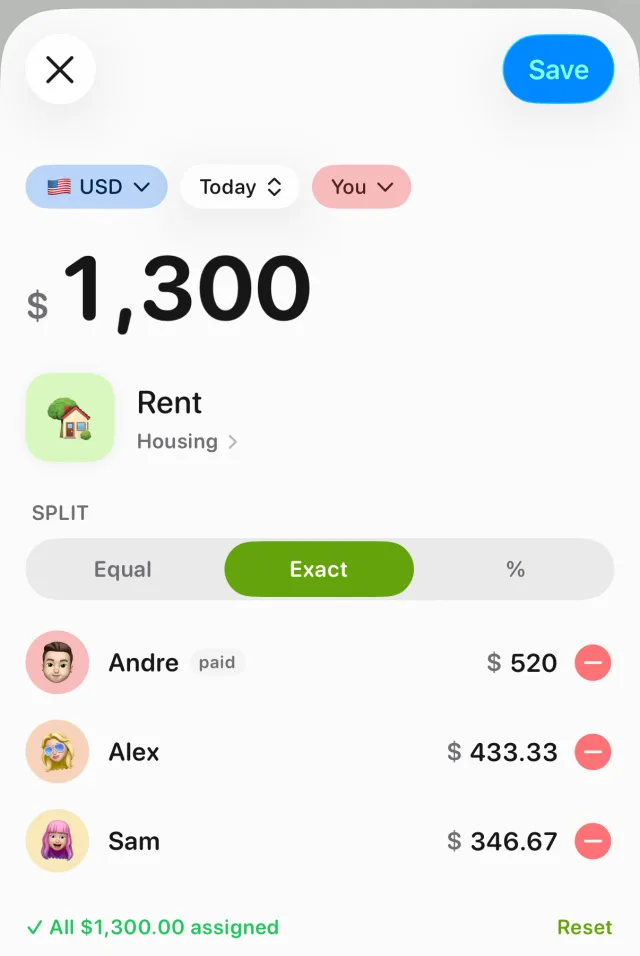
Here is a worked example for $1,300 rent and three bedrooms:
| Roommate | Bedroom | Share of bedroom space | Rent by room size | Half equal, half by size |
|---|---|---|---|---|
| You | 180 sq ft | 40% | $520.00 | $476.67 |
| Alex | 150 sq ft | 33.3% | $433.33 | $433.33 |
| Sam | 120 sq ft | 26.7% | $346.67 | $390.00 |
| Total | 450 sq ft | 100% | $1,300.00 | $1,300.00 |
The last column is a popular middle ground. The kitchen, living room and bathroom are shared by everyone, so half the rent ($650) is split equally ($216.67 each) and only the other half follows bedroom size. It narrows the gap between the biggest and smallest room without ignoring it.
Some households also adjust for features, like an en-suite bathroom or a balcony. If you do, agree on the amount before you sign the lease, not after the first month.
Utilities and internet: usually equal
Electricity, gas, water and internet are hard to measure per person, so most roommates split them equally. If one person works from home all day and runs a space heater, you can agree on a fixed extra amount for them, but keep it simple. Recalculating the electric bill by appliance every month is how friendships end.
Decide who has each account in their name and set it to autopay, so a bill is never late because everyone assumed someone else would pay it.
Groceries: share the staples, not everything
Grocery splitting causes the most friction, because people eat very differently. Three approaches that work:
- Shared staples only. Split things everyone uses (milk, oil, coffee, toilet paper, dish soap) equally. Everyone buys their own meals.
- A household kitty. Everyone puts in the same amount each month and staples come out of it.
- Everything equal. Only works if you cook and eat together most nights.
If one person regularly buys the shared items, log each receipt as a shared cost so it evens out at settle-up time.
Step 3: Write down every shared bill, with who paid
This is the step most households skip, and the reason month three gets awkward. Every time someone pays a shared cost, record:
- what it was and the amount
- the date
- who paid
- who it is split between, and how (equally, by amounts, or by percentage)
A shared spreadsheet works if everyone actually opens it. An app is easier to keep up with, because you can add the bill on your phone the moment you pay it.
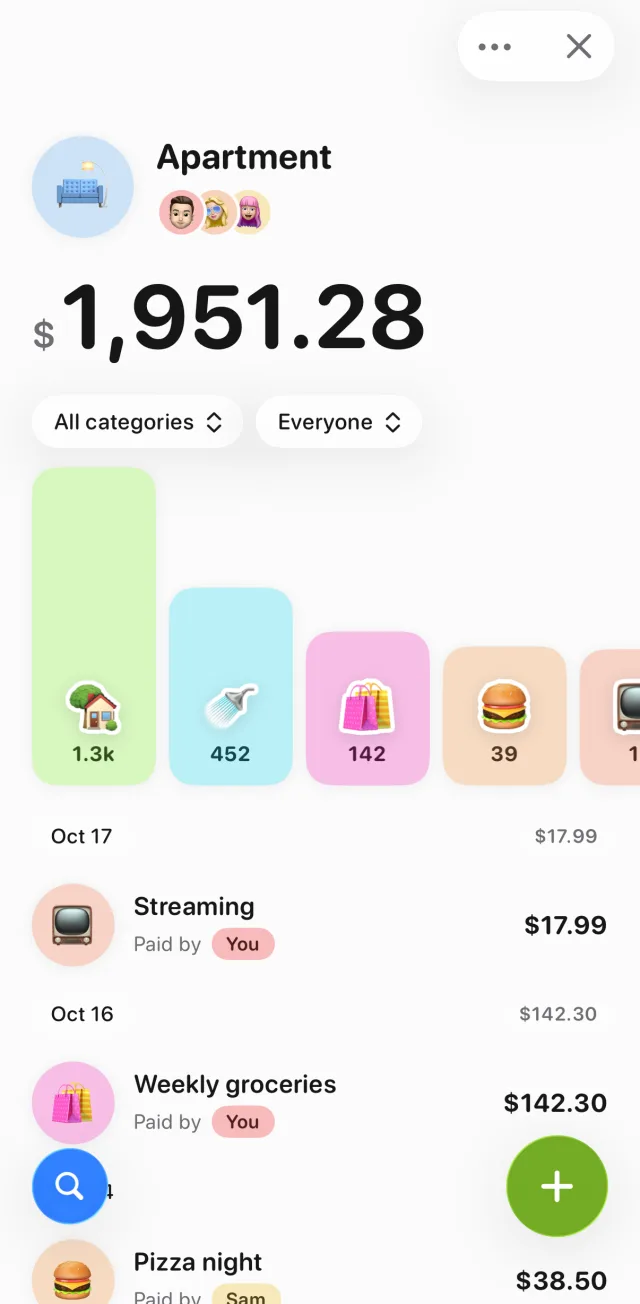
This is the job Tally was built for. You create one shared expense for the apartment, add your roommates by name (they don't need the app to be included), and log each bill with who paid and how it is split: equally, by exact amounts or by percentage. Roommates who do have the app can join the shared expense with a code and add bills themselves.
Step 4: Settle up once a month
Paying each other back after every grocery run is tiring. It is easier to let it build up and settle once a month, for example the day after rent is due.
To settle up, work out each person's balance: what they paid, minus their share of everything. Here is an example month for three roommates, with every bill split equally:
| Roommate | Paid | Share of $1,951.28 | Balance |
|---|---|---|---|
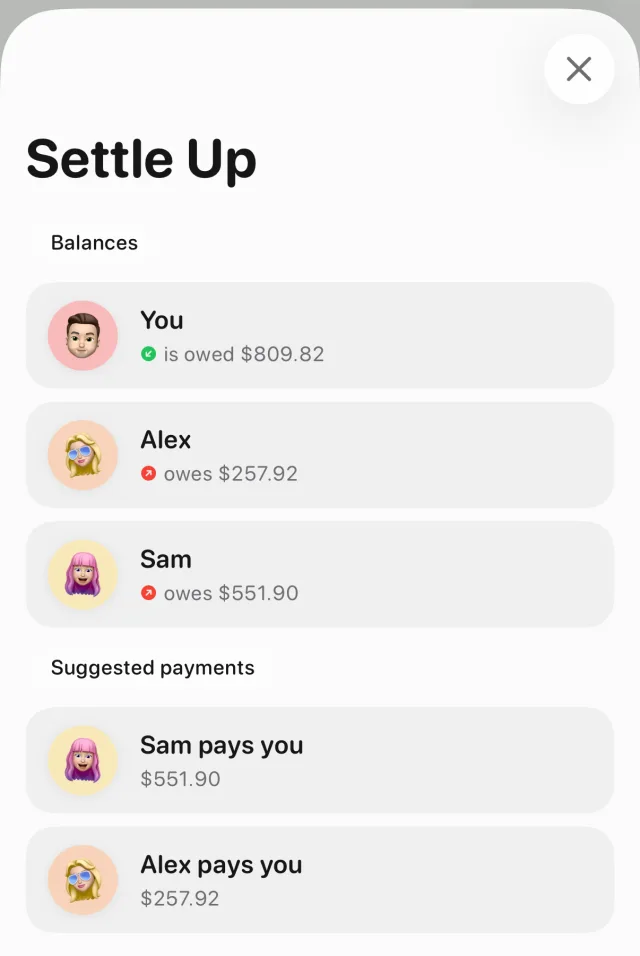
| You | $1,460.29 (rent, groceries, streaming) | $650.47 | is owed $809.82 |
| Alex | $392.50 (electricity, water, gas) | $650.42 | owes $257.92 |
| Sam | $98.49 (internet, pizza night) | $650.39 | owes $551.90 |
The shares differ by a few cents because each bill is split to the cent and the leftover cent goes to someone. The balances always add up to zero, and you don't need to pay each bill back separately. Two payments clear the whole month: Alex pays you $257.92 and Sam pays you $551.90.
With more people it gets harder to see the shortest set of payments by hand. Tally's Settle Up screen does the math: it shows each person's balance and a short list of suggested payments that brings everyone back to zero. It shows who should pay whom; you still send the money yourselves with whatever you normally use.
Step 5: Put the rules in writing
A one-page roommate agreement saves a lot of guessing later. It doesn't need to be formal. Cover:
- how rent is split, and whose name is on each utility account
- how utilities, internet and groceries are split
- when you settle up each month, and how you pay each other
- what happens with guests who stay a lot, and with big shared purchases
- what happens if someone moves out early
It also helps to understand your lease. Many shared leases make every tenant responsible for the full rent, not just their share. Harvard University Housing, for example, tells its co-lessees that they are jointly and severally liable for the entire rent, so if one roommate doesn't pay, the others can be on the hook. Read the terms of your own lease, and check local tenant resources if you are unsure what it means for you.
Tricky situations
Someone moves in or out mid-month. Prorate by days. If Alex's share is $433.33 and Alex moves out after 10 days of a 30-day month, Alex owes $433.33 × 10 ÷ 30 = $144.44 for that month.
Someone is away for weeks. Rent stays the same, since the room is still theirs. Many households agree that groceries pause, and some reduce that person's utility share. Agree on it before the trip, not after.
A partner basically lives there. Talk about it early. A common compromise is that the partner chips in for utilities and groceries.
Roommates earn very different amounts. Some households split rent by income, but it is a personal choice and works best among close friends or couples. Equal or room-size splits are the norm among roommates.

Tally: expense tracker and bill splitter
Log what you spend, split bills with friends in any currency, and see who owes whom when it's time to settle up. Set category budgets and watch them as you go. Free to start.

Common questions
What is the fairest way to split rent with roommates?
If the bedrooms are similar, split it equally. If they differ, split by bedroom size, or split half equally (for shared space) and half by bedroom size. The fairest method is the one everyone agreed to before moving in.
How do you split utilities with roommates?
Most roommates split electricity, gas, water and internet equally. Put each account in one person's name, set it to autopay, and have that person log the bill so everyone pays them back at settle-up.
Should roommates split groceries?
Only the things you actually share, like cooking basics, cleaning supplies and toilet paper. Personal food is usually paid for by each person.
How often should roommates settle up?
Once a month works for most homes. Pick a fixed day, such as the day after rent is due, and clear all balances at once.
Is there an app to split bills with roommates?
Yes. Tally lets you share one expense with your roommates, log each bill with who paid and how it is split, and see who owes whom on the Settle Up screen. Splitting and settling up are included in the free plan.