
How to Split Rent Fairly When Rooms Are Different Sizes
To split rent based on room size, measure each bedroom, add the bedrooms up, and give each person the share of the rent that their room takes of that total. Most households soften it a little: they split the rent for shared space (kitchen, living room, hallways) equally, and only split the bedroom part by size. Then they add a small premium for extras like a private bathroom or a parking spot.
Here are all three methods worked through on the same apartment, so you can see what each one costs every roommate.
The short version: equal works when rooms are close in size. By square footage is simple but can feel harsh on the big room. The fairest middle ground for most homes is a hybrid: shared space split equally, bedrooms by size. Price extras like an en-suite bathroom as fixed monthly amounts, agree on everything before anyone picks a room, and check that the shares add up to the rent exactly.
The example apartment
All the tables below use one made-up apartment. The method works the same in any currency.
- Rent: $2,400 a month
- Total floor area: 1,000 sq ft
- Bedrooms: You 200 sq ft, Alex 140 sq ft, Sam 110 sq ft (450 sq ft of bedrooms in all)
- Shared space: the other 550 sq ft (kitchen, living room, shared bathroom, hallway)
- Extras: your room has a private bathroom, Alex's has a walk-in closet, Alex uses the one parking spot, and Sam's room has the big sunny window
Method 1: Split it equally
Divide the rent by the number of people: $2,400 ÷ 3 = $800 each.
Equal is the right call when bedrooms are within a few square feet of each other and nobody has a clear extra. It is easy to explain and nobody has to measure anything. In our apartment, though, Sam would pay the same $800 for a room just over half the size of yours, which is exactly the situation that starts quiet resentment.
Method 2: Split by square footage
Each person pays their bedroom's share of the total bedroom area.
| Roommate | Room | Share | Rent |
|---|---|---|---|
| You | 200 sq ft | 44.4% | $1,066.66 |
| Alex | 140 sq ft | 31.1% | $746.67 |
| Sam | 110 sq ft | 24.4% | $586.67 |
| Total | 450 sq ft | 100% | $2,400.00 |
The math for your row is $2,400 × 200 ÷ 450 = $1,066.666..., and the same for the others.
What to do with the leftover cent
Rounding each share to the nearest cent gives $1,066.67 + $746.67 + $586.67 = $2,400.01, one cent too much. That happens a lot with thirds. The fix: round every share, then add or remove the leftover cents one at a time until the total matches the rent. Here we took the extra cent off the biggest share, so you pay $1,066.66. Whatever rule you pick, the shares must add up to the rent exactly, or someone is paying a cent the landlord never sees (or the rent comes up a cent short).
The catch with pure square footage is that it charges for bedroom size as if the bedroom were the whole home. You pay almost twice what Sam pays, even though you all share the same kitchen, living room and front door.
Method 3: The hybrid (shared space equal, bedrooms by size)
This is the method most households land on. Part of the rent pays for space everyone uses equally, so that part is split equally. Only the bedroom part follows room size.
The cleanest way to choose the two parts is the floor plan. Here the shared space is 550 of 1,000 sq ft, so:
- 55% of the rent is shared space: $1,320, split equally, is $440 each.
- 45% is bedrooms: $1,080, split by bedroom size (200, 140 and 110 out of 450).
| Roommate | Shared space | Bedroom part | Rent |
|---|---|---|---|
| You | $440 | $480 | $920 |
| Alex | $440 | $336 | $776 |
| Sam | $440 | $264 | $704 |
| Total | $1,320 | $1,080 | $2,400 |
You still pay the most, but the gap between the biggest and smallest room drops from about $480 to $216. Most people find that easier to accept, because it matches how the home is really used.
If you can't find the total square footage, a common shortcut is to call it half and half: split $1,200 equally and $1,200 by bedroom size. In this apartment that gives $933.34, $773.33 and $693.33 (again with one leftover cent placed so the total is exactly $2,400).
Method 4: Add premiums for features
Size isn't everything. A smaller room with its own bathroom can be the best room in the place. The simplest way to account for features is to put a monthly price on each extra, then share the rest of the rent normally.
- Agree on a monthly amount for each extra.
- Take the premiums off the top of the rent.
- Split what's left with your base method.
- Add each person's premiums back to their share.
Say your group agrees on these amounts:
- Private bathroom: $100 (you)
- Walk-in closet: $25 (Alex)
- Parking spot: $50 (Alex)
- Big sunny window: $15 (Sam)
That's $190 in premiums. The remaining $2,210 split equally is $736.666..., so two people get $736.67 and one gets $736.66 to land on exactly $2,210.
| Roommate | Equal part | Extras | Rent |
|---|---|---|---|
| You | $736.67 | $100 | $836.67 |
| Alex | $736.67 | $75 | $811.67 |
| Sam | $736.66 | $15 | $751.66 |
| Total | $2,210 | $190 | $2,400 |
You can stack this on top of Method 2 or 3 instead of an equal split: take the premiums off first, split the rest by size or with the hybrid, then add the premiums back.
How to put a price on a feature
There's no official price for a closet, so pick numbers the group can defend:
- Parking: what a monthly spot nearby costs, or what the lease charges for it.
- Private bathroom: compare local listings for similar rooms with and without one.
- Light, views, quiet: keep these small. They matter, but people value them very differently.
- Still stuck? Everyone writes down what they think a feature is worth, and you use the average.
How utilities differ from rent
Rent pays for space, so splitting it by room size makes sense. Utilities pay for use, and use follows people, not square feet. A bigger bedroom doesn't run the dishwasher more often.
That's why most households that split rent by size still split electricity, gas, water and internet equally. The common exceptions are a room with its own window AC unit or space heater, or someone who works from home all day. Agree on a fixed extra amount for those cases instead of reading the meter room by room. The roommates guide covers utilities, groceries and streaming in more detail.
How to agree on it as a group
The numbers matter less than everyone feeling they had a say. A few habits make that much easier:
- Measure together. Length times width for each bedroom, and agree up front whether closets count. Use the listing's floor plan if it has one.
- Agree on the method and the premiums before anyone picks a room. Once you know which room is yours, it's hard not to argue for the method that suits you.
- Show the whole table. Everyone should see every share and check that the total equals the rent.
- Let the price settle disagreements. If two people want the same room, raise its rent a little and lower the others by the same total until only one person still wants it.
- Write it down, together with the rest of your house rules. The roommates guide has a short checklist for a roommate agreement, including what your lease means if someone doesn't pay.
- Revisit it at renewal. If the rent goes up, percentages carry over on their own; fixed dollar amounts and premiums need a fresh look.
Splitting rent by room size in Tally
Once you've agreed on the numbers, the hard part is doing them the same way every month. Tally is built for exactly that: it holds the split you agreed on and keeps a running balance between roommates.
1. Create one expense for the apartment. Add your roommates by name. They don't need the app to be in the split, and roommates who have it can join the shared expense with a code and log bills themselves.
2. Log the rent with who paid and your split. Whoever pays the landlord is the payer. Then pick the split that matches your table:
- Exact: type each person's dollar amount, like $920, $776 and $704 from the hybrid. Tally shows how much is still unassigned and won't save until the amounts add up to the full rent, so a typo can't slip through.
- %: type each person's percentage. They need to reach 100%, and Tally turns them into dollar amounts that always add up to the rent exactly, handing out any leftover cent for you. Percentages are handy if your rent will change at renewal, since the split carries over.
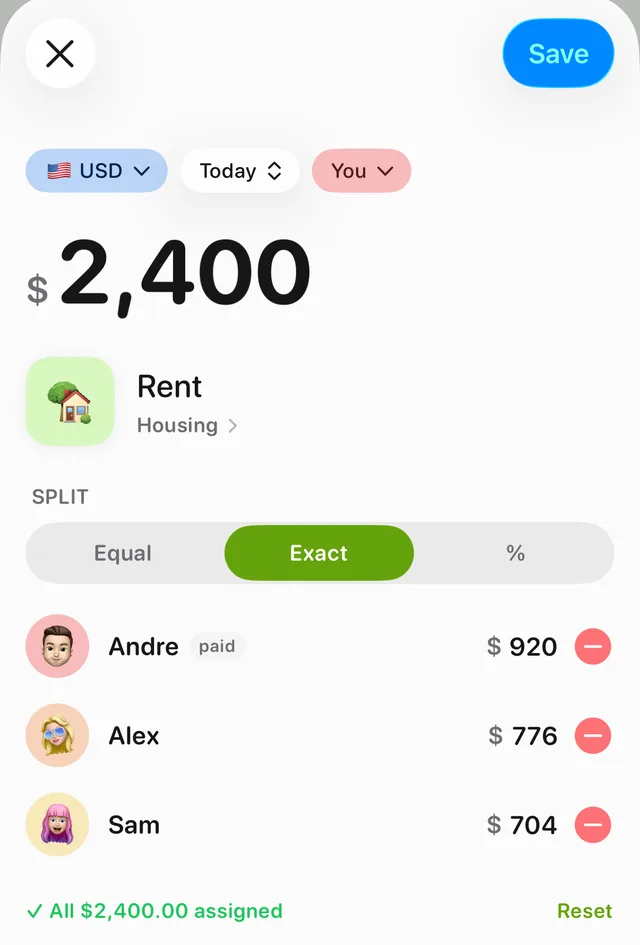
3. Make it recurring. Turn on Make recurring and choose monthly. Tally adds next month's rent on its own, with the same payer and the same split.
4. Split utilities equally. Log each bill as it's paid, with the default Equal split. Rent by room and utilities by head live side by side in the same expense.
5. Settle up once a month. Say you paid the $2,400 rent, Alex paid the $90 electric bill and Sam paid the $60 internet bill. Everyone's share is their rent plus $30 for electricity and $20 for internet:
| Roommate | Paid | Share | Balance |
|---|---|---|---|
| You | $2,400 | $970 | is owed $1,430 |
| Alex | $90 | $826 | owes $736 |
| Sam | $60 | $754 | owes $694 |
| Total | $2,550 | $2,550 |
Tally's Settle Up screen does this math for you and lists the payments that bring everyone back to zero: here, Alex pays you $736 and Sam pays you $694.
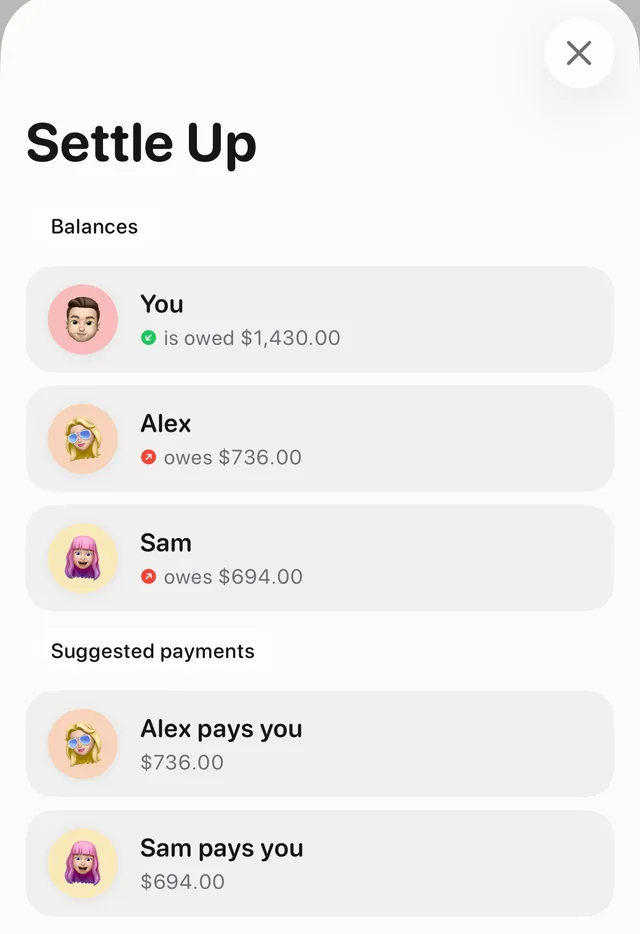
Tally shows who pays whom; you send the money with whatever you normally use. Splitting, recurring bills and Settle Up are all in the free plan, which includes up to 5 expenses you create and 2 budgets. Expenses you join don't count toward that limit, and Tally+ removes the caps.

Tally: expense tracker and bill splitter
Log what you spend, split bills with friends in any currency, and see who owes whom when it's time to settle up. Set category budgets and watch them as you go. Free to start.

Common questions
What is the fairest way to split rent with different room sizes?
For most homes, the hybrid: split the share of rent that pays for shared space equally, and split the bedroom share by square footage. Add fixed premiums for extras like a private bathroom. The fairest method is the one everyone agreed to before choosing rooms.
How do you calculate rent by square footage?
Divide each bedroom's area by the total bedroom area, then multiply by the rent. A 200 sq ft room out of 450 sq ft of bedrooms pays 200 ÷ 450 of the rent, or 44.4%.
How much more should the master bedroom pay?
There's no standard amount. Work it out from size, then add a premium for any private bathroom or extra closet. In the example above, the biggest room pays $920 with the hybrid method, $120 more than an equal $800 share, before any bathroom premium.
Should utilities be split by room size too?
Usually not. Utilities follow how much people use, not how big their room is, so most roommates split them equally even when rent is split by size.
What if the shares don't add up to the rent?
That's rounding. Round each share to the cent, then add or remove single cents until the total matches the rent exactly. Agree once on who takes the odd cent, or rotate it.