
How to Split Travel Expenses with Friends (Without the Awkward Math)
A group trip is the best kind of shared expense until the last night, when someone opens a notes app and starts asking who paid for the taxi on Tuesday. The trip itself is rarely the problem. The problem is a pile of receipts in three wallets and two currencies, and nobody sure what anyone owes.
The fix is the same for a weekend away or two weeks abroad: agree on the rules before you leave, write down every shared cost the moment it is paid, and settle up once at the end. Here is how, with a full worked example.
The short version: before the trip, agree on what is shared, how it is split and when you will settle. During the trip, let one person pay each bill and log it right away: what it was, the amount, the currency, who paid and who it is split between. Convert everything into one home currency. At the end, work out each person's balance and clear it with as few payments as possible.
Step 1: Agree on the rules before you go
Five minutes in the group chat before the trip saves an hour of arguing after it. Settle these questions:
- What is shared? Usually lodging, car rental, gas, groceries and group meals. Flights are often booked and paid separately.
- How is each cost split? Equally by default, with exceptions you name up front.
- What is not shared? Souvenirs, solo activities, and anything one person orders just for themselves.
- Which currency do you settle in? Pick the one you all use at home.
- When do you settle? The last day, or within a few days of getting home.
| Cost | Usual way to split |
|---|---|
| Lodging (hotel, rental, campsite) | Equally per person, or by nights stayed |
| Car rental, gas, tolls, parking | Equally among the people in the car |
| Group meals | Equally, unless orders are very different |
| Drinks | Only among the people drinking |
| Groceries and snacks for the group | Equally |
| Tickets and activities | Only among the people who went |
Step 2: One payer per bill, logged right away
Splitting every bill at the table, with three cards and a confused waiter, gets old by day two. It is easier to let one person pay each bill and even it out later. Just take turns, so nobody ends up fronting the whole trip.
The rule that makes this work: log each shared cost as soon as it is paid, before the receipt disappears into a pocket. For each one, write down:
- what it was and the amount
- the currency it was paid in
- who paid
- who it is split between, and how
A shared spreadsheet can do this, but on a trip it usually goes stale by the second day. A phone app is easier to keep up with, because you can add the bill while you are still standing at the counter.
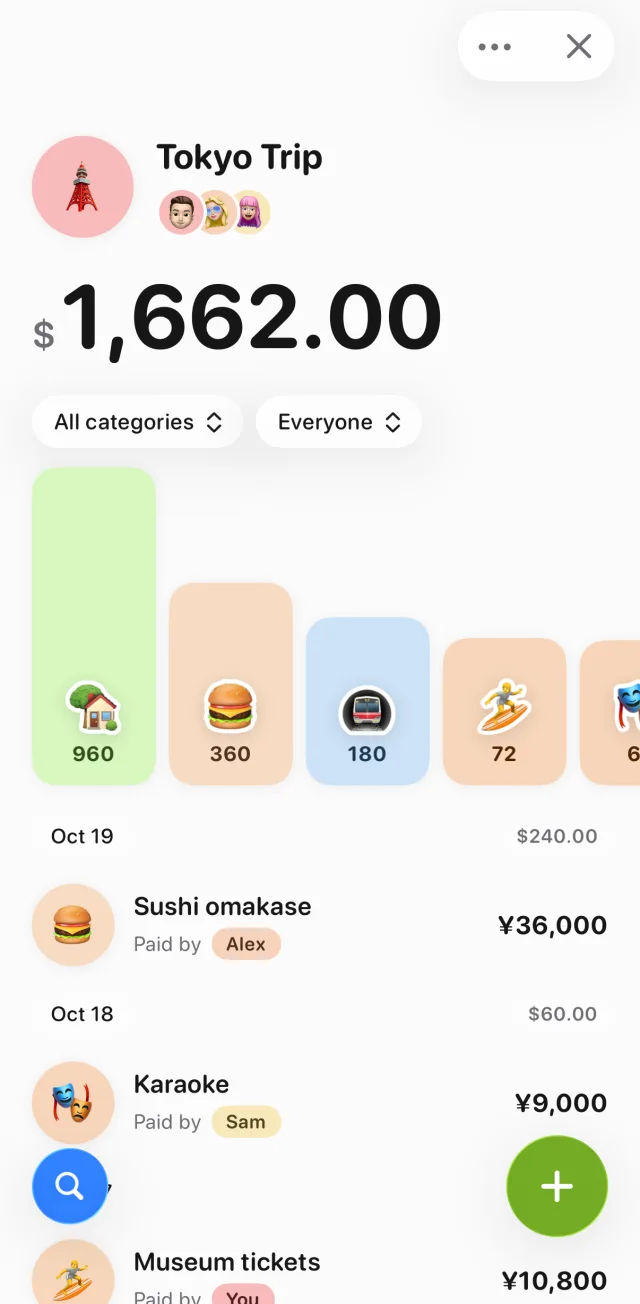
In Tally, you create one expense for the trip and add your friends by name. They don't need the app to be included. Friends who do have it can join the trip with a code and log the bills they pay themselves. Each bill records who paid and how it is split: equally, by exact amounts or by percentage.
Step 3: Handle foreign currency
Abroad, you will pay in the local currency, but you want to settle in your home currency. The simplest approach:
- Choose one home currency for the trip. Every balance is worked out in it.
- Log each bill in the currency you actually paid, the amount on the receipt.
- Convert it at an agreed rate, and use that same conversion when you settle.
The question groups forget to agree on is which rate. Your bank's rate on the day the card statement posts will not exactly match the rate on the day you paid, and fees can differ between cards. Most groups pick one rule, such as "the rate on the day we log it", and accept that it will be a little off from what each bank charged. It beats waiting weeks for statements.
One more thing at the card machine: abroad, a shop or ATM may offer to charge you in your home currency instead of the local one. That is called dynamic currency conversion. Visa requires the merchant to show the exchange rate and any markup and to let you decline, and says the merchant must not choose on your behalf. Compare the amounts before you accept.
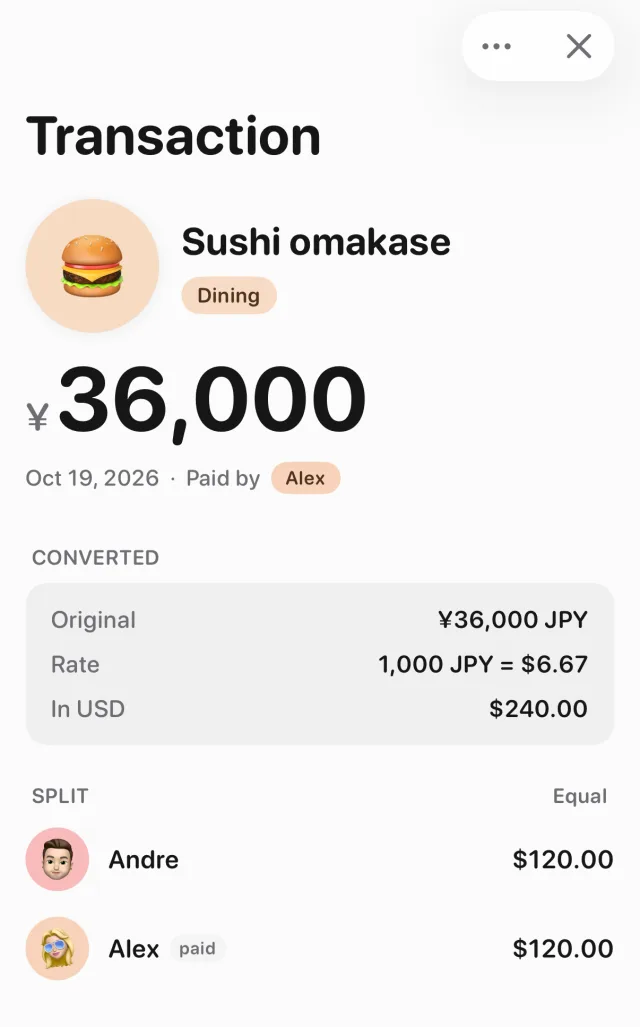
Tally does the conversion as you log. Each bill can be in its own currency, and Tally converts it to the trip's home currency with the rate locked at the moment you enter it, so the numbers don't shift later. Exchange rates refresh in Settings.
Step 4: Split only among the people who took part
Equal splits are the default, but not everything on a trip is shared by everyone. Two friends go to a fancy dinner, one skips the boat tour, one person doesn't drink. Rather than keep a separate tally of side debts, log those costs in the same place and split them only among the people involved.
For uneven costs, use exact amounts. Say a rental costs $960 for 4 nights ($240 a night, $80 per person per night with three people) and Sam leaves after 2 nights. Sam's share is 2 × $80 = $160. The remaining $800 is split between the other two: $400 each. Check: $160 + $400 + $400 = $960.
Step 5: Settle up at the end, with as few payments as possible
Don't pay each other back bill by bill. Add everything up at the end, work out each person's balance, and clear it in one go.
Here is a worked example: three friends, Tokyo, a rental booked at home in dollars and everything else paid in yen. To keep the math readable, it uses a made-up round rate of ¥150 to the dollar. Real rates change every day; the method works in any currency.
| Bill | Paid by | Amount | Split |
|---|---|---|---|
| Apartment rental | You | $960 | All three |
| Izakaya dinner | Alex | ¥18,000 = $120 | All three |
| Day trip train tickets | Sam | ¥27,000 = $180 | All three |
| Convenience store snacks | Alex | ¥4,500 = $30 | All three |
| Museum tickets | You | ¥10,800 = $72 | All three |
| Karaoke | Sam | ¥9,000 = $60 | All three |
| Sushi omakase | Alex | ¥36,000 = $240 | You, Alex |
| Total | $1,662 |
Six bills ($1,422) are shared by all three, so that is $474 each. The omakase ($240) is shared by two, so $120 each. Each person's balance is what they paid minus their share:
| Friend | Paid | Share | Balance |
|---|---|---|---|
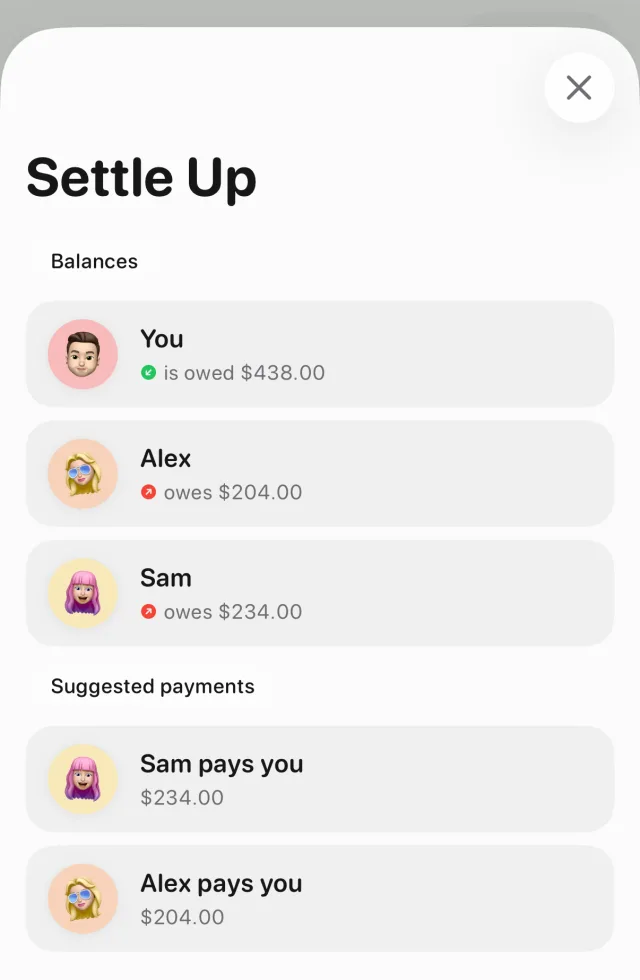
| You | $1,032 (rental, museum) | $594 ($474 + $120) | is owed $438 |
| Alex | $390 (dinner, snacks, omakase) | $594 ($474 + $120) | owes $204 |
| Sam | $240 (trains, karaoke) | $474 | owes $234 |
The balances always add up to zero: $438 − $204 − $234 = $0.
Now compare the ways to pay it back. Settling bill by bill, everyone owes everyone: six separate debts between three people, running in both directions. Netting each pair cuts it to three payments (Alex pays you $174, Sam pays you $264, Alex pays Sam $30). Netting the whole group cuts it to two: Alex pays you $204 and Sam pays you $234. Everyone ends at zero.
With three people you can do this on a napkin. With six people and forty bills, it gets slow. Tally's Settle Up screen does it for you: it shows each person's balance and a short list of suggested payments that brings everyone back to zero. It shows who should pay whom; you send the money yourselves, with whatever you normally use.
When you do send money through a payment app, the FTC's advice is to double-check the recipient's information to make sure you're sending money to the right person. It is an easy mistake to make when several friends have similar usernames.
Tricky situations
One person booked something big for everyone. Flights, a rental deposit, concert tickets bought months ahead: log them in the trip like any other bill, with that person as the payer. They get paid back at the end with everything else. If the amount is large, some groups settle that one early so nobody carries it for months.
Someone joins late or leaves early. Split lodging by nights stayed, as in Step 4, and leave them out of the meals and activities they missed.
A cash kitty. Some groups each put the same amount into a shared pot for small things like street food and tips. Since everyone put in the same amount, things bought from the kitty are already split equally and don't need logging. Split any leftover cash evenly at the end.
Different budgets. If one friend is on a tighter budget, agree on it before booking, not at the restaurant. Splitting only what people choose to join (Step 4) keeps it fair without making anyone explain themselves.
Planning a weekend at home instead? The same steps work for a cabin trip or a girls' weekend: one shared expense, one payer per bill, settle up once. If you share costs every month, see how to split bills with roommates.

Tally: expense tracker and bill splitter
Log what you spend, split bills with friends in any currency, and see who owes whom when it's time to settle up. Set category budgets and watch them as you go. Free to start.

Common questions
What is the fairest way to split travel expenses with friends?
Split shared costs equally among the people who used them, and agree on any exceptions before the trip. Lodging can be split by nights stayed, drinks among the people drinking, activities among the people who went. Settle once at the end, not bill by bill.
How do you split costs on a trip when people pay in different currencies?
Choose one home currency for the group. Log each bill in the currency you paid, convert it at an agreed rate (for example, the rate on the day you log it), and work out all balances in the home currency.
Should one person pay for everything on a group trip?
It is simpler for one person to pay each bill, but take turns so nobody fronts the whole trip. Log every bill with who paid, and the balances even out at settle-up.
What is the easiest way to settle up after a trip?
Work out each person's balance (what they paid minus their share), then have the people who owe pay the people who are owed. With three friends, that is usually two payments, not a dozen.
Is there an app to split travel expenses with friends?
Yes. Tally lets you create one expense for the trip, add friends by name, log bills in any currency with who paid and how it is split, and see who owes whom on the Settle Up screen. Splitting and settling up are included in the free plan.