
The 50/30/20 Rule, Explained with Real Numbers
The 50/30/20 rule is a simple way to divide your take-home pay: about 50% for needs, 30% for wants and 20% for savings (many versions also put extra debt payments in that 20%). On $4,000 a month after taxes, that's $2,000 for needs, $1,200 for wants and $800 for savings. It's a target for the big picture, not a line-by-line budget, and plenty of people adjust the numbers to fit their life.
The short version: start from your monthly income after taxes, not your salary. Multiply by 0.5, 0.3 and 0.2 to get your three targets. Sort each spending category into need, want or savings. After a month of tracking, divide each bucket's total by your take-home pay to see your real split, then decide what, if anything, to change.
This post explains the method and the arithmetic. It isn't financial advice, and the dollar amounts below are round, made-up numbers chosen to make the math easy to follow.
What the 50/30/20 rule says
The Consumer Financial Protection Bureau's classroom worksheet on analyzing budgets puts it in one sentence: look at your "monthly net income and plan to use 50 percent of it on needs, 30 percent on wants, and 20 percent on savings goals." North Dakota State University Extension's 50/30/20 budget sheet says the same: after calculating your monthly net income, "use 50% for needs, 30% for wants and 20% for savings."
| Share | Bucket | What goes in it |
|---|---|---|
| 50% | Needs | Housing, groceries, utilities, insurance, getting to work |
| 30% | Wants | Eating out, entertainment, nonessential shopping, trips |
| 20% | Savings | Savings goals, and in many versions extra debt payments |
Net income means take-home pay: what lands in your account after taxes and other deductions. If your paycheck already takes out retirement contributions, you can choose to count those toward the 20% by adding them back to your take-home figure first. Either way, decide once and use the same rule every month.
Where debt payments go (sources differ)
This is the part where descriptions of the rule don't agree, so it's worth being explicit:
- The CFPB worksheet and the NDSU sheet call the third bucket savings and don't mention debt. NDSU does list car payments as an example of a need.
- Experian's guide to the 50/30/20 budget rule calls it "savings and debt payments." It puts minimum debt payments (such as an installment loan bill or a credit card minimum) in needs, because falling behind has serious consequences, and puts extra payments beyond the minimum in the 20%.
The worked example below follows that last split: minimums are needs, anything extra is in the 20%. If you count it differently, that's fine; just be consistent so your month-to-month numbers compare.
Where the rule comes from
The rule is generally credited to Elizabeth Warren and her daughter Amelia Warren Tyagi. A 2019 Bloomberg article (republished by WealthManagement.com) describes their book All Your Worth, "first published in 2005," as having "popularized a simple budget plan: 50% on needs, 30% on wants and 20% on savings." Experian also dates it to 2005, when Warren "championed the 50/30/20 plan" in All Your Worth: The Ultimate Lifetime Money Plan. Today's descriptions of the rule, including the ones quoted above, use their own wording for the categories, which is part of why the debt question has more than one answer.
A worked monthly example
Say your take-home pay is $4,000 a month. The targets are:
- Needs: $4,000 × 0.5 = $2,000
- Wants: $4,000 × 0.3 = $1,200
- Savings and extra debt: $4,000 × 0.2 = $800
Here's one way those targets could turn into category limits. Again, these are invented round numbers, not a recommendation for what anything should cost:
| Category | Bucket | Plan |
|---|---|---|
| Housing | Need | $1,250 |
| Groceries | Need | $350 |
| Utilities and phone | Need | $150 |
| Transport | Need | $100 |
| Health | Need | $50 |
| Debt minimums | Need | $100 |
| Needs | 50% | $2,000 |
| Eating out | Want | $300 |
| Coffee | Want | $50 |
| Shopping | Want | $200 |
| Entertainment | Want | $150 |
| Subscriptions | Want | $50 |
| Gifts | Want | $150 |
| Travel | Want | $300 |
| Wants | 30% | $1,200 |
| Savings | Save | $500 |
| Extra debt | Save | $300 |
| Savings | 20% | $800 |
Two things stand out. First, housing alone is 31% of take-home pay in this example, which leaves only $750 for every other need. That's why housing is usually the line that decides whether 50% is realistic. Second, the wants bucket is bigger than it looks at first glance: $1,200 covers a lot of dinners. The rule deliberately leaves room for fun, which is one reason people find it easier to stick to than a strict budget.
If you're not sure which categories to use, the budget categories list has a starting set of 15 with examples. Each of them fits into one of the three buckets.
Needs vs wants: the gray areas
Most categories sort themselves. Rent is a need; concert tickets are a want. The trouble is in the middle, and Experian points out that whether something is a need or a want "can vary from person to person." Its examples: dry cleaning can be a necessity if your job has a dress code, and a gym membership isn't technically essential, but it's reasonable to count it as one if staying active is what keeps you well.
A useful way to handle the middle ground is to split a category into its basic part and its extra part:
- Groceries are a need. The premium version of the same shop is partly a want. Most people don't split receipts, but it helps to know that a big grocery bill isn't automatically "all needs."
- Phone and internet are needs today. The top-tier plan or the newest phone on installments is where the want part lives.
- Clothing: basics and work clothes are needs; NDSU gives "brand-name clothing" as an example of a want.
- Transportation: getting to work is a need. A nicer car than you need for that is partly a want, even though the payment arrives as one bill.
- Subscriptions are usually wants, even the ones that feel permanent.
- Gifts and holidays feel like obligations, but most versions of the rule would count them as wants.
Don't agonize over each line. The rule works at the level of three buckets, so a few misfiled dollars won't change the picture. What matters is deciding once and filing the same way every month.
When the rule fits, and when people adjust it
The 50/30/20 split is a starting point. Experian describes it as "just a recommendation" and lists situations where it's hard to follow. Here are the common ones, with what people tend to do about them.
High-cost housing. If rent or a mortgage takes most of your take-home pay, needs can't fit in 50% without heroic cuts. People in that spot often run a different split, such as 60/20/20, taking the extra 10% out of wants so savings stays at 20%. Experian mentions that kind of adjustment, and also notes that the rule may not suit people with low incomes or who live in expensive areas.
Paying down debt. Some people temporarily move money from wants into the third bucket to pay a debt off faster. Experian notes a downside of the rule here: because savings and debt repayment share one 20% bucket, neither may get as much weight as someone focused on one of them would want. If that's you, you can split the 20% into two lines (as in the example above) and decide the mix yourself.
Irregular income. Freelancers, gig workers and anyone paid on commission don't have one monthly number to multiply. Experian suggests using an average of your earnings as a baseline, or switching to a method built for irregular income such as zero-based budgeting. Some people prefer to plan around a lower, typical month and treat anything above it as extra.
Already saving more than 20%. Nothing about the rule says to stop at 20%. NDSU points out that if you don't spend all 30% on wants, "you can put the remaining amount into savings" on top of the 20%.
Whatever split you land on, write it down as three numbers. A plan of "60/20/20 until the car loan is gone" is easier to check than "spend less."
How to check your own split from a month of tracking
The rule is most useful as a check on what you actually spend. The CFPB worksheet's method is exactly that: list each expense under needs, wants or savings goals, add up each column, then "divide the category total by the monthly net income to determine the percentage."
- Track a full month. Every purchase, with a category. If you haven't started, how to track your spending covers the daily habit and the review.
- Total each category for the month.
- Label each category need, want or savings. Use the same labels every month.
- Add up each bucket. Include money you moved to savings and any extra debt payments, which are easy to forget because they don't feel like spending.
- Divide each bucket by your take-home pay and compare with your plan.
Here's what a month might look like for the example above. Made-up numbers again:
| Bucket | Plan | Actual | Share |
|---|---|---|---|
| Needs | $2,000 | $2,150 | 54% |
| Wants | $1,200 | $1,050 | 26% |
| Savings | $800 | $750 | 19% |
The other $50 (1%) was left in the checking account. The useful reading isn't "needs are over, that's bad." It's specific: groceries, transportation, a dentist visit and a slightly higher utility bill pushed needs up by $150, while wants came in under. From here there are a few honest options: trim needs where you can, keep wants lower to make up the gap, or accept a 54/26/20 split for now. Moving the leftover $50 to savings would bring that bucket back to $800. Which one makes sense is your call.
Run the check for two or three months before changing much. One month can be skewed by a yearly bill or a trip, and an average tells you more.
Setting up a 50/30/20 budget in Tally
Tally doesn't have a 50/30/20 mode, and it can't group categories into needs, wants and savings or set a limit as a percentage. A budget in Tally is a named set of dollar limits, one per category. But that's enough to run the rule with a little setup, and it's how the screenshots below were made (in Tally's demo mode, with the example numbers from this post).
Make one budget whose limits add up to your take-home pay. Create a budget (here called "50/30/20") and type a limit next to each category. Set the needs categories so they add up to 50% of your take-home pay, the wants to 30%, and add Savings and Extra debt categories for the 20%. The total at the top of the budget adds up as you type, so when it matches your monthly take-home pay, every dollar has a line.
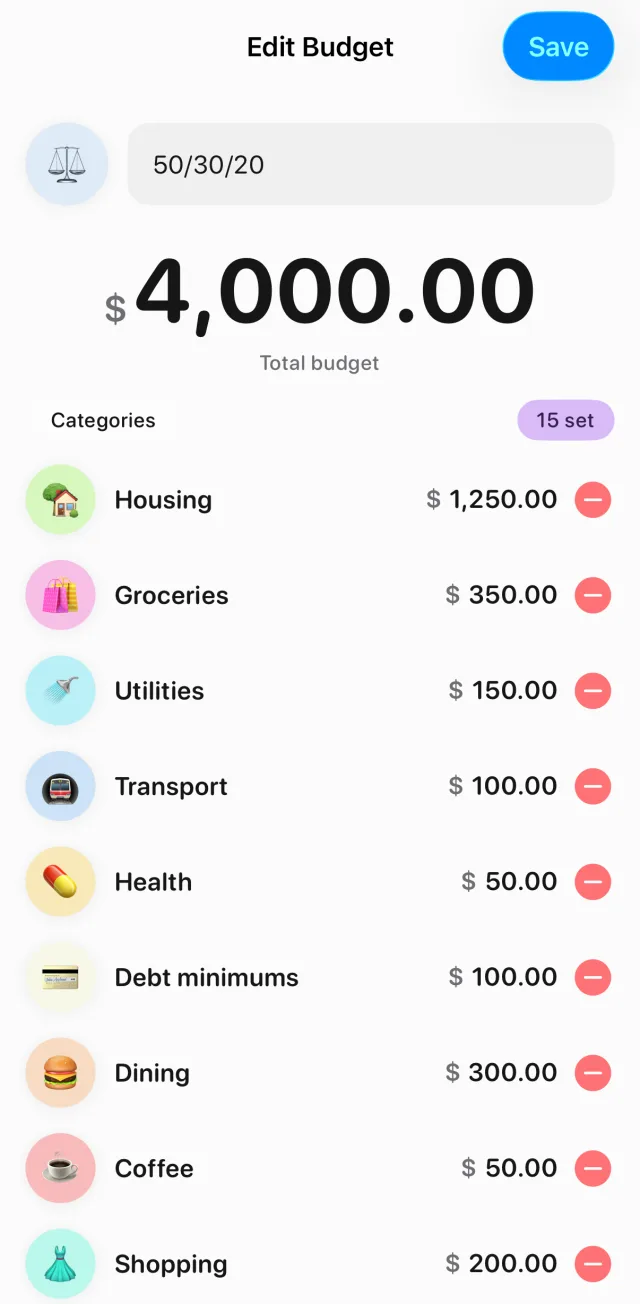
Log savings as a transaction too. Tally tracks spending, not bank balances, so to see savings in your split, log the transfer itself ("Transfer to savings, $500") in the Savings category on the day you make it. Same for an extra debt payment. They'll then show up next to everything else.
Use one expense for the month. Attach the budget to the expense you log your everyday spending in. You can give an expense start and end dates, like the "October" expense here, or keep one ongoing expense and use the month filter that appears once it has two or more months of activity. The spend-by-category chart at the top then shows the month at a glance, biggest category first, with each category's limit drawn on it.
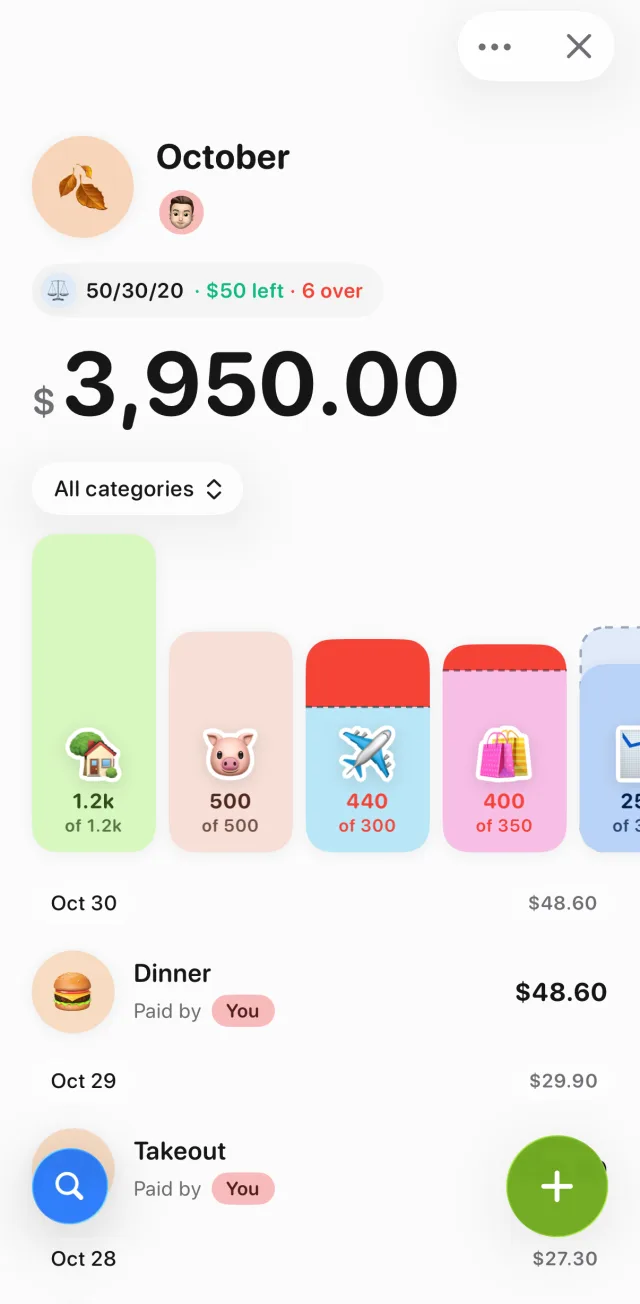
Read the split from the budget page. The budget page shows spent against limit for each category and the budget as a whole, with categories that went over shown in red. Because Tally can't add up a group of categories for you, the bucket totals are a quick sum you do yourself: add the needs categories, add the wants, add Savings and Extra debt. Then divide each by your take-home pay, as in the table above.
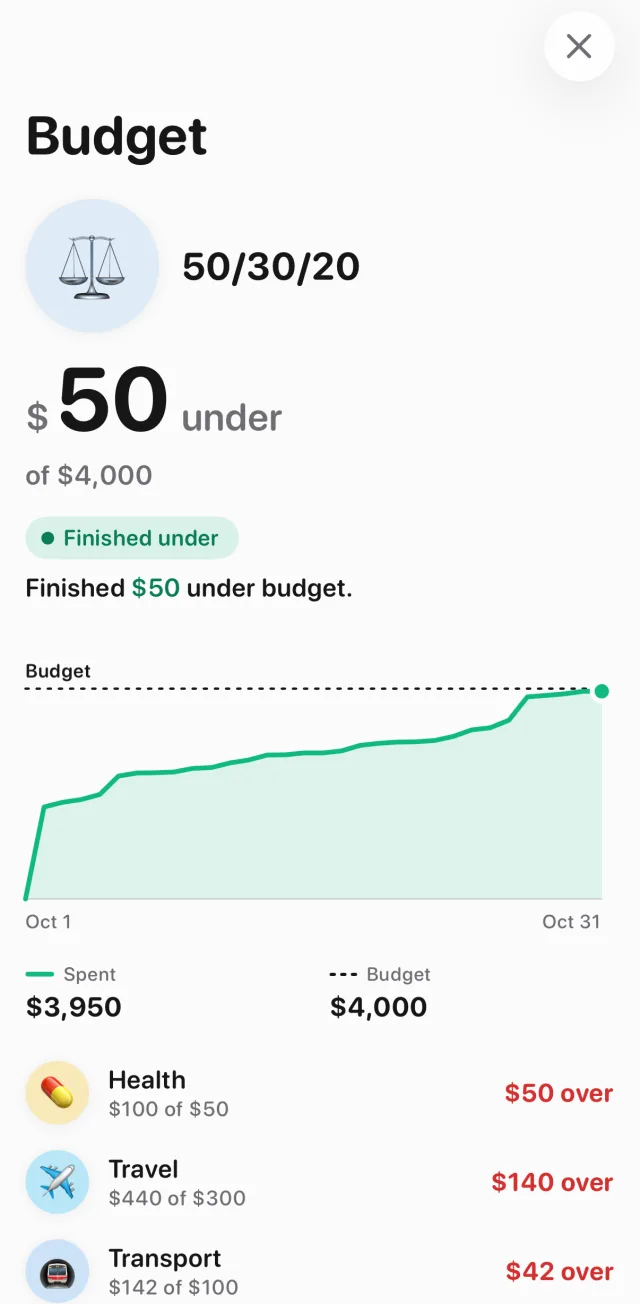
A simpler alternative: if you only care about the three buckets, make just three categories called Needs, Wants and Savings and give each its limit. You lose the detail of where the money went, but the chart becomes the 50/30/20 check by itself.
Your take-home pay doesn't live in the budget, so keep that number handy. If you log income in Tally's Wallet (it needs a free sign-in with Apple or Google), it shows your month across all your expenses: income plus your share of spending. On the free plan you can create up to 5 expenses and 2 budgets, which covers this setup. Tally doesn't connect to your bank, so purchases and transfers are entered by hand.

Tally: expense tracker and bill splitter
Log what you spend, split bills with friends in any currency, and see who owes whom when it's time to settle up. Set category budgets and watch them as you go. Free to start.

Common questions
What is the 50/30/20 rule in simple terms?
Split your take-home pay into three parts: about half for needs like housing and groceries, about 30% for wants like eating out and entertainment, and about 20% for savings. Many versions also count extra debt payments in the 20%.
Is the 50/30/20 rule based on gross or net income?
Net income, meaning your take-home pay after taxes. The CFPB worksheet, the NDSU Extension sheet and Experian's guide all start from monthly net or after-tax income.
Are debt payments needs or savings under the 50/30/20 rule?
It depends on the source. Experian counts minimum debt payments as needs and extra payments as part of the 20%. The CFPB and NDSU versions describe the 20% as savings and don't mention debt. Pick one approach and use it consistently.
Who created the 50/30/20 rule?
It's generally credited to Elizabeth Warren and Amelia Warren Tyagi, whose book All Your Worth, first published in 2005, popularized the 50% needs, 30% wants and 20% savings split.
What if my needs are more than 50% of my income?
That's common, especially where housing is expensive. Some people use a different split, such as 60/20/20, taking the difference from wants. Track a month or two first so you know the real number before choosing.
How do I calculate 50/30/20 for my income?
Multiply your monthly take-home pay by 0.5, 0.3 and 0.2. On $3,000 a month, that's $1,500 for needs, $900 for wants and $600 for savings.