
Budget Categories List: A Simple Starting Set
A practical budget categories list has about 12 to 15 groups: the big fixed bills (housing, utilities, phone, insurance, debt), the everyday flexible spending (groceries, eating out, transportation, personal care, fun), and a few categories for costs that don't show up every month (car maintenance, gifts, yearly bills). Below is a starting set of 15 with what goes in each, then a simple way to give every category a limit using last month's numbers.
The short version: start with the list below and delete what doesn't apply to you. Mark each category as fixed, flexible or irregular. Set fixed limits to the bill, flexible limits to last month's spending (then trim one or two), and irregular limits to the yearly cost divided by 12. Review once a month.
This is a method for organizing your own money, not financial advice. If you haven't tracked your spending yet, start with how to track your spending: the limits below work best when they come from a month of real numbers.
The starting list: 15 budget categories
Each category gets a type. Fixed costs are roughly the same every month. Flexible costs change with your choices. Irregular costs are real but don't arrive monthly, which is why budgets so often miss them.
| Category | What goes in it | Type |
|---|---|---|
| Housing | Rent or mortgage, renters or home insurance, property tax, HOA fees | Fixed |
| Utilities | Electricity, gas, water and sewer, trash, internet | Fixed, varies by season |
| Phone | Your cell plan, phone payments | Fixed |
| Groceries | Food for home, cleaning and paper goods, toiletries | Flexible |
| Eating out | Restaurants, takeout, delivery, coffee, work lunches | Flexible |
| Transportation | Gas, transit, parking, tolls, rides, car payment, car insurance | Mixed |
| Car care | Oil changes, tires, repairs, registration, inspections | Irregular |
| Health | Premiums you pay yourself, co-pays, prescriptions, dental, eye care | Mixed |
| Debt payments | Credit cards, student loans, car or personal loans | Fixed minimums |
| Subscriptions | Streaming, music, apps, cloud storage, gym, memberships | Fixed, easy to forget |
| Personal care and clothing | Haircuts, toiletries, clothes, shoes, dry cleaning | Flexible |
| Fun | Movies, concerts, hobbies, sports, games, books | Flexible |
| Gifts and giving | Birthdays, holidays, weddings, donations | Irregular |
| Yearly bills | Annual subscriptions, insurance paid once a year, renewals, back to school | Irregular |
| Savings | Emergency fund, goals, a trip | Fixed, if you set it |
Add these only if they apply: Childcare and education (daycare, tuition, school supplies, activity fees), Pets (food, vet, grooming) and Travel if you take more than one trip a year. Keep an Other category too, but treat it as a warning light: if it gets big, something in it deserves its own name.
A few notes on the gray areas, because these are the ones people argue with themselves about every month:
- Coffee and snacks go in Eating out, unless coffee is a habit you want to watch. Then give it its own category for a month or two.
- Car insurance sits in Transportation if you pay monthly. If you pay every six or twelve months, put it in Yearly bills and set money aside each month (more on that below).
- Household items like a new pan or a lamp can live in Groceries if they're small, or in Other if they're occasional.
- Shared bills count at your share. If you split a $150 internet bill three ways, your Utilities line gets $50. If you share bills with roommates or a partner, see how to split bills with roommates and how to split bills as a couple.
Where this list comes from
It's a slightly expanded version of the 12 categories in the Consumer Financial Protection Bureau's spending tracker, with three changes: utilities get their own line instead of sharing one with housing, subscriptions come out of "Entertainment + personal care" because they're easy to lose track of, and the irregular costs (car care, gifts, yearly bills) get their own categories so they stop being surprises.
The big three deserve the most detail. In the Bureau of Labor Statistics Consumer Expenditures 2024 release, housing was 33.4% of average annual spending for US consumer units (roughly, households), transportation 17.0% and food 12.9%. Your numbers will differ, but those are usually the categories where a small change makes the biggest difference, so it helps to see inside them (groceries vs eating out, car payment vs gas vs repairs).
Fixed, flexible and irregular: why the type matters
Sorting categories by type is what turns a list into a plan.
Fixed costs are the bills you already know. The CFPB tracker suggests circling the items "that are the same every month (like rent, car, or cell phone payments)," because these are often your needs and obligations, and knowing them makes creating a budget easier. A fixed category's limit is simply the bill.
Flexible costs are where your choices show up: groceries, eating out, clothes, fun. These are the categories where a limit actually changes behavior, and the CFPB tracker suggests looking here for areas you could cut back on.
Irregular costs are the ones a monthly budget misses. They're predictable over a year but lumpy month to month. The fix is to budget for them every month, even in months when nothing is due.
The categories people forget
Most budgets that "don't work" are missing one of these. The CFPB's savings plan worksheet asks two good questions: do you have money set aside for "expenses that come one to four times per year" (its examples include car insurance, renter's insurance, back to school costs, birthdays and holidays), and for unexpected ones like "a flat tire or other car trouble," medical costs or a new appliance?
Check your list against these:
- Yearly and twice-yearly bills. Insurance paid in one go, annual app or streaming plans, membership renewals, professional fees.
- Car maintenance. Oil changes, tires, brakes, registration and inspections. Even a reliable car costs something most years.
- Gifts and holidays. Birthdays, weddings, the end-of-year holidays. The CFPB's tips for managing spending suggest deciding how much to set aside for special occasions "so that you can enjoy life without overspending."
- Subscriptions. Each one is small and renews quietly. Give them one category so you can see the total.
- Home and health odds and ends. A new kettle, a dental visit, glasses. Not monthly, but rarely zero over a year.
- Cash. No statement will remind you, so log it when you spend it.
Turning a yearly cost into a monthly limit is simple division. Add up what the category cost over the last year (or your best estimate), then divide by 12. For example, with made-up numbers: if birthdays and holidays come to about $480 a year, the Gifts category gets $40 a month. In months with no gifts, that $40 isn't spent; it waits for December.
How many budget categories should you have?
Enough to answer "where did the money go?", few enough that every purchase takes one second to file. For most people that's somewhere between 10 and 15.
- Just starting? Fewer is fine. If you're only tracking, 8 to 12 categories is plenty, as in the tracking guide.
- Setting limits? Add the irregular categories (car care, gifts, yearly bills) even if they make the list longer. They're the ones that protect the rest of the budget.
- Split a category when it's big and you want to change part of it. "Food: $690" tells you less than "Groceries: $430, Eating out: $260."
- Merge categories when they're tiny or you never act on them. Reading and Hobbies can both be Fun.
- Keep names you'd use out loud. If you have to stop and think which category a purchase belongs to, decide once and write the rule down.
How to set a limit for each category
Use last month's spending as the starting point, not a guess. The CFPB tips suggest tracking "for a week or a month to see how much you're spending in different categories" before you set limits, then comparing your actual spending to your budget monthly or more often.
- Write down last month's total for each category. If you have two or three months, use the average; one month is fine to start.
- Fixed categories: limit = the bill. Rent, phone, minimum debt payments, subscriptions you're keeping.
- Flexible categories: start at what you spent, then trim one or two. Pick the categories where you'd most like to spend less, and lower them by a round amount you can actually hit.
- Irregular categories: yearly cost divided by 12. Even if last month was zero.
- Check the total against your income. Consumer.gov's making a budget guide: subtract your monthly bills and expenses from your monthly income, and if the result is below zero, look for things you can change.
- Review at the end of the month. If a category is over every month, the limit was a wish, not a plan. Raise it and find the money elsewhere, or change the habit.
Here's a worked example for one person. The numbers are round and made up, just to show the arithmetic:
| Category | Last month | New limit | Why |
|---|---|---|---|
| Housing | $1,200 | $1,200 | Fixed |
| Utilities | $140 | $150 | Up for winter |
| Groceries | $430 | $420 | Small trim |
| Eating out | $260 | $200 | Biggest trim |
| Transport | $180 | $180 | Same |
| Subscriptions | $64 | $45 | Cancel two |
| Car care | $0 | $50 | Yearly ÷ 12 |
| Gifts | $0 | $40 | Yearly ÷ 12 |
| Total | $2,274 | $2,285 |
Car care assumes about $600 a year and Gifts about $480, each divided by 12. Notice that the total barely moved. The trims to eating out, subscriptions and groceries ($89) paid for most of the two irregular categories that last month didn't show at all ($90) and the winter bump in utilities ($10). That's normal for a first budget, and it's the point: the next car repair or birthday is already covered instead of landing on a credit card.
Setting up categories and limits in Tally
Tally doesn't ship a fixed category list, so you start with your own set. That makes it a good fit for a list like the one above: make the categories you'll use and skip the rest.
Your own categories. In Settings, Categories, tap the dashed tile to add one with a name, an emoji and a color. Expense and income categories are kept apart with a switch at the bottom, so your Groceries and Paycheck never mix.
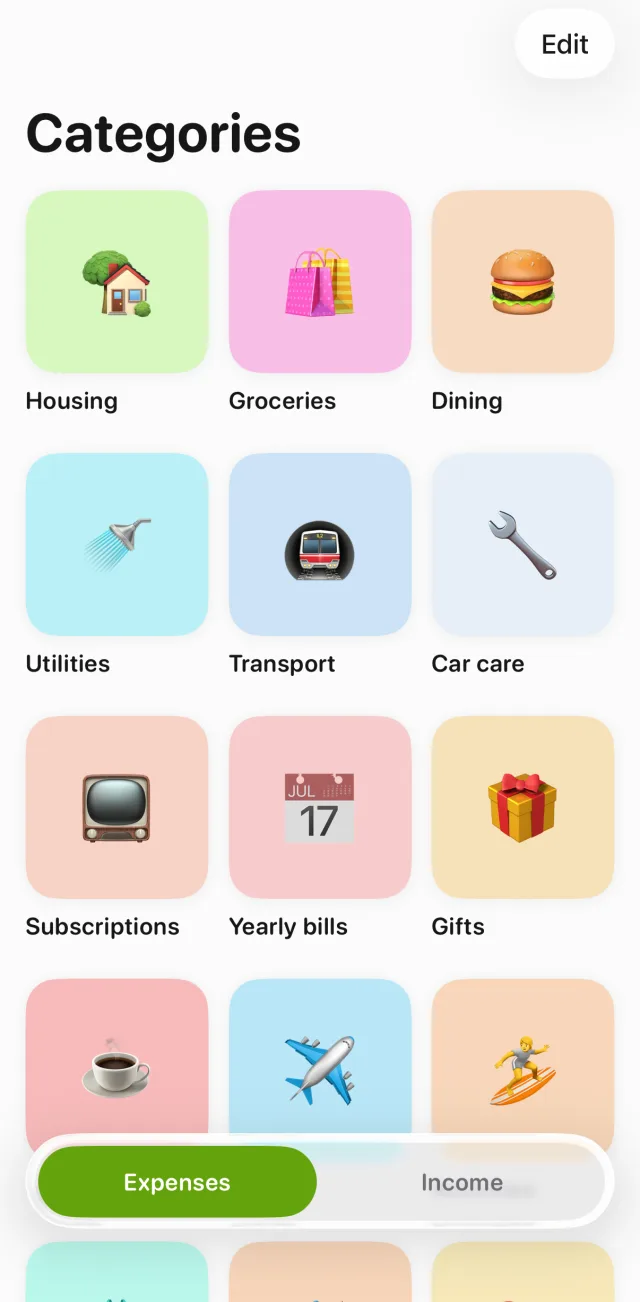
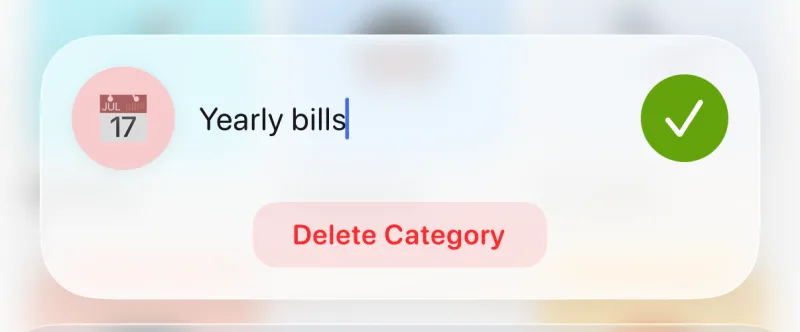
Editing one. Tap a category to rename it, or tap its emoji to change the emoji and color. Renaming changes it everywhere you've used it.
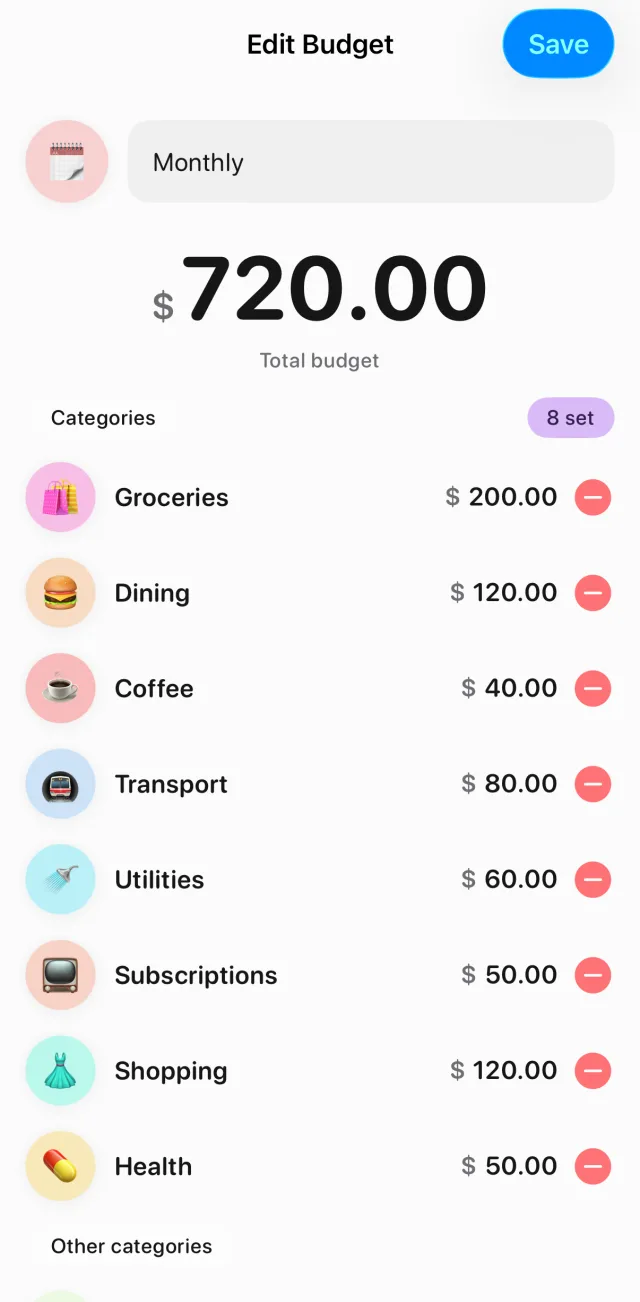
Limits per category. A budget in Tally is a named set of limits per category, like "Monthly". Type a limit next to each category you want to watch; categories without a limit sit in a separate list below. The total at the top adds up as you type, which makes step 5 above a glance instead of a sum. Attach the budget to the expense you log your everyday spending in, and each month it shows spent vs limit per category.
Logging into the right category. Each transaction gets a category when you add it. With Tally+ (free for each account's first week), the form can suggest a category from what you type, which helps the rules from your gray-areas list stick.
On the free plan you can create up to 5 expenses and 2 budgets, which covers one everyday budget plus one for a trip or a shared home. Tally doesn't connect to your bank, so purchases are entered by hand. For the full monthly routine, see how to track your spending, which covers the daily habit and the review.

Tally: expense tracker and bill splitter
Log what you spend, split bills with friends in any currency, and see who owes whom when it's time to settle up. Set category budgets and watch them as you go. Free to start.

Common questions
What are the main categories of a budget?
Most budgets cover housing, utilities, food (split into groceries and eating out), transportation, health, debt payments, personal spending and savings. Add categories for the costs that don't come monthly, like car care, gifts and yearly bills.
How many budget categories should I have?
Usually 10 to 15. Fewer if you're only tracking where money goes, a few more once you set limits, so irregular costs have their own lines.
What's the difference between fixed and flexible expenses?
Fixed expenses are about the same every month, like rent, a phone plan or a loan payment. Flexible expenses change with your choices, like groceries, eating out and entertainment. Irregular expenses are a third group: predictable over a year but not monthly.
How do I budget for expenses that only happen once a year?
Add up the yearly cost and divide by 12, then budget that amount every month in its own category. With $600 a year of car maintenance, that's $50 a month set aside.
Should savings be a budget category?
Many people include it so that saving is planned rather than whatever is left. The CFPB's spending tracker lists savings for emergencies and goals under its Other category.