
How to Split Bills as a Couple: 50/50, by Income, or by Category
Most couples split shared bills in one of three ways: 50/50, where each person pays half; by income, where each person pays the same percentage of what they earn; or by category, where each person takes over certain bills. None of them is the "right" one. Each is fair by a different definition, and the best fit is the one you both agree to and can keep up without resentment.
Below, all three are worked through with the same example household, so you can see what each one means in dollars.
The short version: list your shared monthly costs. For 50/50, each pays half. For an income split, each pays their share of your combined income: if you bring in 60% of it, you cover 60% of the bills. For a category split, each person owns certain bills outright. Whatever you pick, log who paid what, check the balance once a month, and revisit the deal when your incomes or costs change.
The FDIC describes the same basic options in its guide to sharing finances as a couple: combine everything, agree on who pays which expenses, or divide costs by percentage of income. This post walks through the arithmetic. It is not financial or legal advice.
The example household
To compare the methods, here is one made-up couple, You and Alex. The numbers are round on purpose and only for illustration; the method works the same in any currency.
You take home $6,000 a month and Alex takes home $4,000, so together you bring in $10,000. Your shared costs:
| Shared cost | Per month |
|---|---|
| Rent | $2,000 |
| Utilities and internet | $250 |
| Groceries | $600 |
| Streaming, household supplies, dinners out | $150 |
| Total | $3,000 |
Personal things stay personal: your own phone plan, clothes, hobbies and anything only one of you uses.
Method 1: Split 50/50
Add up the shared costs and each person pays half. Here that is $1,500 each.
| You | Alex | |
|---|---|---|
| Pays | $1,500 | $1,500 |
| Share of take-home pay | 25% | 37.5% |
| Left over each month | $4,500 | $2,500 |
Pros: it is the simplest to explain and to calculate. Nobody has to share income details, and it feels natural to couples with similar incomes or who are early in the relationship.
Cons: when incomes differ, the same dollar amount is a bigger slice of the smaller paycheck. In the example, Alex spends 37.5% of take-home pay on shared costs while you spend 25%. Some couples are fine with that; others find it starts to feel lopsided, especially when the higher earner picks the apartment or the restaurant.
Method 2: Split by income (proportional)
Each person pays the same percentage of their income, so the higher earner pays more in dollars. The math takes two steps:
- Find each person's share of your combined income. Your share is your income divided by the total: $6,000 ÷ $10,000 = 60%. Alex's is $4,000 ÷ $10,000 = 40%.
- Apply that share to the shared costs. You pay 60% of $3,000 = $1,800. Alex pays 40% of $3,000 = $1,200.
| You | Alex | |
|---|---|---|
| Share of combined income | 60% | 40% |
| Pays | $1,800 | $1,200 |
| Share of take-home pay | 30% | 30% |
| Left over each month | $4,200 | $2,800 |
Both of you now spend 30% of take-home pay on shared costs. A quick way to check any income split: the shared total divided by the combined income ($3,000 ÷ $10,000 = 30%) should match the percentage each person pays.
Pros: many couples see it as fairer when incomes are far apart, since each person gives up the same proportion of what they earn. It also adjusts itself: if one income changes, recalculate the percentages and the dollar amounts follow.
Cons: you have to share income numbers and agree on which ones to use. Take-home pay or gross salary? What about bonuses, side income or months with no income? Decide once and write it down. The percentages also need updating when pay changes, or the split quietly drifts.
Method 3: Split by category
Instead of splitting every bill, each person takes over whole bills. One common version: one partner pays the rent, the other pays utilities, groceries and everything else.
| You | Alex | |
|---|---|---|
| Takes over | Rent | Utilities, groceries, everything else |
| Pays | $2,000 | $1,000 |
| Share of take-home pay | 33% | 25% |
Notice that this lands close to the income split in the example, but not exactly on it, and it would stay the same if Alex's income doubled. You can also pick categories to roughly match 50/50 or your income shares, then accept that some months will be a little off.
Pros: there is very little to track. Each person sets up autopay for their own bills and nobody has to pay anyone back. It can also suit couples who each want to "own" something, like one person doing the groceries and the other handling the bills.
Cons: bills change size while the arrangement doesn't. Groceries creep up, a heating bill doubles in winter, and suddenly one person is carrying more without either of you deciding that. Over time it is easy to lose track of what each person actually pays, so check the totals now and then.
The three methods side by side
| Method | You pay | Alex pays | Best when |
|---|---|---|---|
| 50/50 | $1,500 | $1,500 | Incomes are similar, or you want it simple |
| By income | $1,800 | $1,200 | Incomes differ and you want equal effort |
| By category | $2,000 | $1,000 | You want little tracking and stable bills |
Plenty of couples mix them. For example: fixed costs like rent and utilities by income, and fun spending like dinners out and trips 50/50. Or each person pays a monthly amount, by income or equally, into a shared pot that covers the bills, and the rest stays in individual accounts.
If that pot is a joint bank account, know how it works before you open one. The FDIC notes that each co-owner of a joint account has equal rights to make withdrawals, and the CFPB says that in most cases either person on a joint checking account can withdraw money from and close the account. Your bank's account agreement has the details for your account.
How to make any method work
Agree on what counts as shared. Rent and groceries, sure. But what about the car only one of you drives, the dog, a gym membership, gifts for each other's families? Settle the gray areas once, before they come up one at a time.
Talk about it when nothing is wrong. A calm conversation over coffee goes better than one in the middle of an argument about the electric bill. If one of you earns little or nothing for a while, for example during study, a job search or caregiving, that is worth discussing openly too. Some couples switch methods during those stretches; that is a personal decision, not a math problem.
Log who paid what. With 50/50 or income splits, you rarely pay every bill in exactly the right ratio. One person pays the rent, the other pays most of the groceries, and it evens out at the end of the month. That only works if both of you can see what was paid.
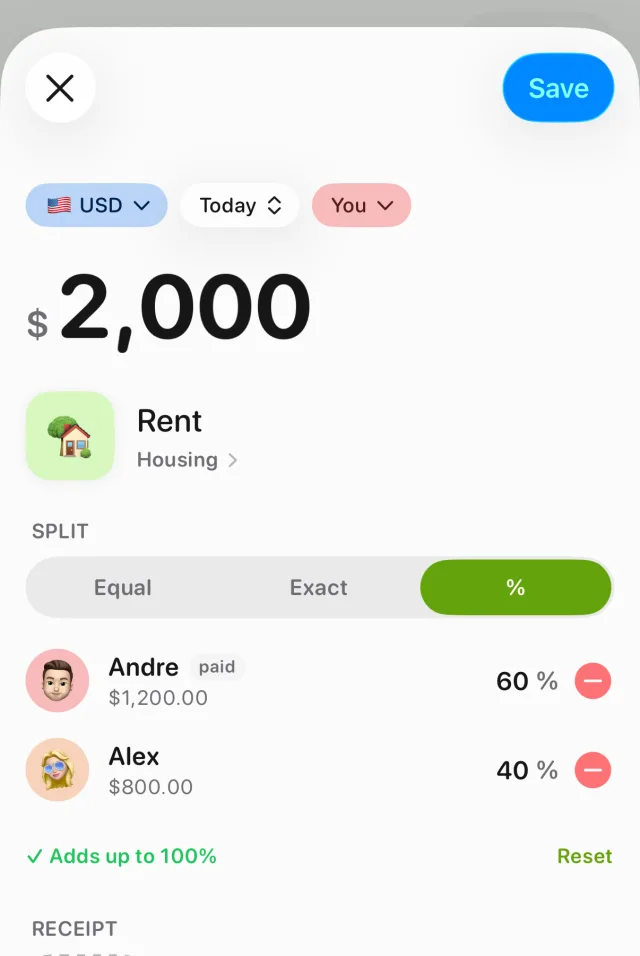
Tally handles that part. You create one shared expense for your home, add your partner (they can join it with a code from their own phone, or you can just add them by name), and log each bill with who paid. Each bill can be split equally, by exact amounts or by percentage, so a 60/40 income split is a couple of taps.
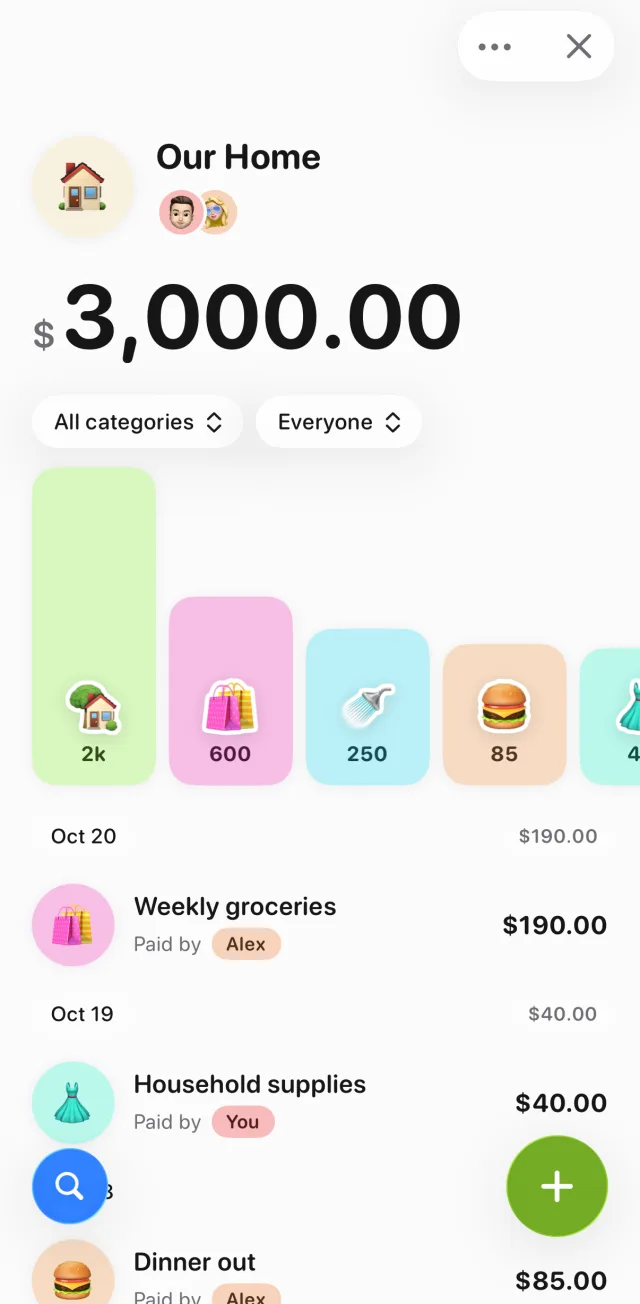
Settle up once a month. Instead of paying each other back bill by bill, add it all up at the end of the month. Here is what a month looks like for the example couple, with every bill split 60/40:
| Paid | Share (60/40) | Balance | |
|---|---|---|---|
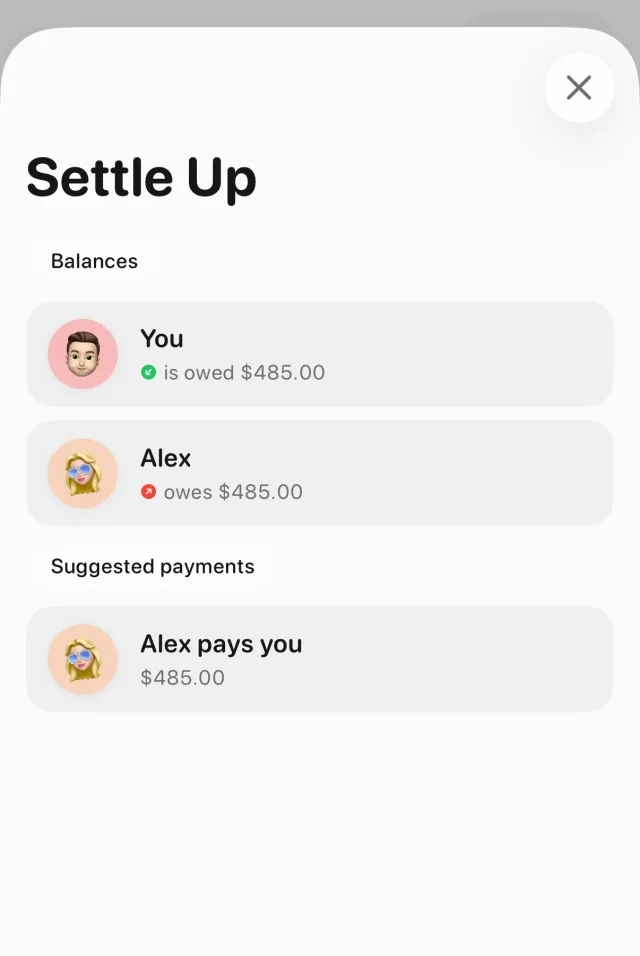
| You | $2,285 (rent, groceries, streaming, supplies) | $1,800 | is owed $485 |
| Alex | $715 (utilities, internet, groceries, dinner) | $1,200 | owes $485 |
One payment clears the month: Alex pays you $485. If the same bills were split 50/50 instead, each share would be $1,500, and Alex would owe you $785.
Tally's Settle Up screen does this math for you: each person's balance and the payment that brings you both back to zero. It shows who should pay whom; you move the money yourselves, however you normally do. It is also a handy check for the category method: log your bills split by your target ratio, and the balance tells you how far your arrangement has drifted from it.
Revisit it. A raise, a new job, a baby, a move: any of these can make last year's split feel wrong. A quick check-in a couple of times a year keeps the arrangement matching your life.
If you have shared bills with roommates before, much of this will feel familiar; see how to split bills with roommates for rent by room size and monthly settle-ups. And for a holiday together or with friends, there is a guide to splitting travel expenses, including foreign currency.

Tally: expense tracker and bill splitter
Log what you spend, split bills with friends in any currency, and see who owes whom when it's time to settle up. Set category budgets and watch them as you go. Free to start.

Common questions
What is the fairest way to split bills as a couple?
There is no single fair way. A 50/50 split is fair in dollars; an income split is fair in effort, since each person pays the same share of what they earn; a category split is fair if both of you agree the bills you each cover are balanced. The fairest method is the one you both chose and keep reviewing.
How do you split bills based on income?
Divide each person's income by your combined income to get their percentage, then pay that percentage of each shared bill. If you take home $6,000 and your partner $4,000, you pay 60% and they pay 40%.
Should couples split bills 50/50 if one makes more?
Some do and some don't. With very different incomes, 50/50 takes a bigger share of the smaller paycheck, which is why many couples switch to an income split or a mix. It is a personal choice, not a rule.
Should we use gross or take-home income for an income split?
Either works if you are consistent. Take-home pay reflects what each of you actually has to spend, while gross salary is easier to look up. Agree on one and on how to treat bonuses and irregular income.
Is there an app to split bills as a couple?
Yes. Tally lets you share one expense with your partner, log each bill with who paid and split it equally, by exact amounts or by percentage, and see who owes whom on the Settle Up screen. Splitting and settling up are included in the free plan.