
How to Budget for a Trip: Estimate, Set a Daily Budget, Track It
To budget for a trip, split it into two parts. First, the big costs you can price before you leave: getting there and where you'll sleep. Second, the costs you pay on the ground: food, local transport, activities and extras. Estimate the second part per day, multiply by the number of days, add a buffer, and you have a total. Then, while you travel, compare what you've spent with that daily number every evening.
The short version: price your transport and lodging from real quotes. Set a daily amount for food, local transport, activities and extras, and multiply by the number of days. Convert foreign costs at one planning rate, leave room for card and ATM fees, and add a buffer (10% in the example below). On the trip, log what you spend each day by category and check it against the daily budget, so you can adjust while there's still time.
This post is about the method and the arithmetic, not financial advice. All the prices below are round, made-up numbers chosen to keep the math easy to follow, not what a trip "should" cost.
Step 1: List the categories
Almost every trip budget fits into six categories. Thinking in categories, rather than one big number, is what makes the estimate realistic: you can price each one separately, and later you can see which one is running over.
| Category | What goes in it |
|---|---|
| Transport there and back | Flights, trains, buses, or gas, tolls and parking for a road trip |
| Lodging | Hotel, rental, hostel or campsite, plus taxes and cleaning fees |
| Food | Restaurants, cafes, groceries, snacks, drinks |
| Local transport | Metro, buses, taxis and rideshares, day trips by train |
| Activities | Tickets, tours, classes, museums, shows |
| Extras | SIM card or data plan, tips, toiletries you forgot, souvenirs |
Two of these are usually booked ahead: transport and lodging. The other four are paid as you go. That split matters, because the booked costs are known before you leave, while the pay-as-you-go costs are the ones a budget actually has to control.
If you already keep a monthly budget, a trip can be its own small budget instead of one "Travel" line. The budget categories list covers the everyday categories; this post is about the trip itself.
Step 2: Price the costs you book ahead
Don't guess transport and lodging from an average you read somewhere. Get real quotes for your dates: the fare search, the rental or hotel listing, the train timetable. Write down the total price including taxes and fees, not the headline nightly rate.
For lodging shared with friends, divide the total by the number of people (or by nights stayed, if someone arrives late). The guide to splitting travel expenses with friends covers the fair ways to divide shared costs; here we only need each person's share.
Step 3: Set a daily budget for everything else
For the four pay-as-you-go categories, pick an amount per day. Base it on what you know: menu prices and ticket prices on official sites, transit fares from the local transport operator, and your own habits (are you a three-restaurant-meals person or a bakery-and-picnic person?).
Then multiply each daily amount by the number of days. Count days, not nights: an 8-day trip with 7 nights has 8 days of meals.
A worked example: 8 days in Lisbon
Two friends, 8 days and 7 nights, one person's budget. To keep the math readable, it uses a made-up round rate of $1.10 per euro. Real rates change daily; the method works with any currency.
The flight quote is $900. The apartment is $1,960 for 7 nights, split two ways, so each person's share is $980. For the days on the ground, the plan is €50 a day for food, €10 for local transport, €30 for activities and €10 for extras: €100 a day.
| Category | Plan | Euros | Dollars |
|---|---|---|---|
| Flight | Quote | $900 | |
| Lodging | $1,960 ÷ 2 | $980 | |
| Food | €50 × 8 days | €400 | $440 |
| Local transport | €10 × 8 days | €80 | $88 |
| Activities | €30 × 8 days | €240 | $264 |
| Extras | €10 × 8 days | €80 | $88 |
| Subtotal | $2,760 | ||
| Buffer | 10% | $276 | |
| Total | $3,036 |
Checking the arithmetic: the four daily categories add up to €800, which is $880 at $1.10. Add the flight and lodging ($900 + $980 = $1,880) and the subtotal is $2,760. A 10% buffer is $276, so the total is $3,036.
The number to carry on the trip is the daily one: €100 a day, or $110. The flight and lodging are already paid. What's left to manage is $880 over 8 days.
Why a buffer, and how big?
Something always comes up: a taxi in the rain, a museum you didn't plan for, a fee you didn't expect. A buffer is a line for it, so going over in one category doesn't mean going over overall. There's no official right size; 10% here is just a round choice for the example. Some people base it on the pay-as-you-go part only, since the booked part is already fixed. Whatever you pick, write it down as its own line so you can see when you start using it.
Step 4: Plan for exchange rates and card fees
If the trip is abroad, the pay-as-you-go costs are in another currency, and two things make the real cost differ from your estimate: the exchange rate and fees.
Pick one planning rate. Look up a current rate when you make the budget and use it for every line. For US dollars, the Federal Reserve publishes weekly foreign exchange rates for major currencies. Rates move, so round your planning rate slightly in the cautious direction, or let the buffer absorb the difference.
Check your card's fees before you go. The FDIC's travel money tips say to ask your bank, before you travel, about any fees "such as an ATM or foreign transaction fees" for using your debit or credit card at your destination. For US credit cards, a fee on purchases in a foreign currency is one of the transaction charges that federal rules (Regulation Z, section 1026.60) require issuers to list in the fee table that comes with a card application or offer, so you can usually find it in your card's terms.
To budget for a fee, multiply your foreign spending by the fee rate. Say your card's terms listed a 3% fee (a made-up figure for the math; use your own card's number). On the example's €800 of on-the-ground spending, that's €800 × 0.03 = €24, or $26.40 at $1.10. If your card has no such fee, that line is zero.
Cash and ATMs. The FDIC suggests carrying only enough cash "for local transit, tips, and other small expenses," and warns that getting cash from an ATM with a credit card "can incur hefty fees," while a debit card may cost less. It also notes that when you exchange cash, "the fee is usually the same whether you exchange $10 or $100," so converting larger amounts less often keeps that cost down. Your own bank's fee schedule tells you what a withdrawal abroad costs.
Choose the local currency at the card machine. Shops and ATMs abroad may offer to charge you in your home currency instead. That's called dynamic currency conversion. Visa requires the merchant or ATM to show the exchange rate and any extra fees or markup, and says they must not choose on your behalf. The FDIC's advice is that if your card doesn't charge foreign transaction or currency conversion fees, you should choose the local currency and let your bank do the exchange. Either way, compare the amounts before you accept.
Leave room for holds. Hotels and car rental companies often "block" part of your credit line when you check in, to cover the expected bill. The FDIC explains that a hotel usually blocks the cost of the stay plus incidentals, and a car rental the rental plus fuel. A hold isn't spending, so it doesn't belong in the budget, but if your card is close to its limit, other purchases could be declined.
Step 5: Track spending against the budget while you're away
A trip budget made at home and never looked at again tells you, at the end, that you went over. Tracking it during the trip tells you on day four, when you can still do something about it.
The habit is the same one from how to track your spending, compressed into a trip:
- Log each purchase the same day, with its category and the currency you paid in.
- Every evening, compare the running total with the plan so far. On day 3 of 8, the plan so far is 3 × €100 = €300.
- Look at categories, not just the total. If activities are running hot but food is under, you might be fine overall.
- Recalculate what's left per day. Money left divided by days left is your new daily budget.
The example, on day 6
Here's the Lisbon budget after 6 of the 8 days. These are one person's shares of the bills, converted at the same $1.10 rate:
| Category | Budget | Spent | Left |
|---|---|---|---|
| Food | $440 | $223.30 | $216.70 |
| Local transport | $88 | $41.80 | $46.20 |
| Activities | $264 | $275.00 | $11 over |
| Extras | $88 | $28.60 | $59.40 |
| Total | $880 | $568.70 | $311.30 |
The plan for 6 days was 6 × $110 = $660, and $568.70 has gone, so the trip is about $91 under pace. Activities have already passed their whole-trip budget (a surf lesson and a fado show will do that), but food came in well under, so the total is fine. With $311.30 left and 2 days to go, there's $311.30 ÷ 2 = $155.65 a day available, more than the original $110.
That's the useful part of tracking by category: instead of "we're spending too much," you know exactly which line went over, and whether another line covers it.
When you get home, compare the final numbers with the plan. The categories you misjudged are the ones to estimate differently next time.
Budgeting a trip in Tally
Tally can hold the whole example: the trip, the friends, the euros and the budget. The screenshots below were made in Tally's demo mode with the Lisbon numbers from this post.
One expense for the trip. Create an expense for the trip ("Lisbon Trip" here), set its start and end dates, and choose a base currency (here, dollars). Add your travel companions by name; they don't need the app. Then log each bill as you pay it, with a category, who paid and how it's split.
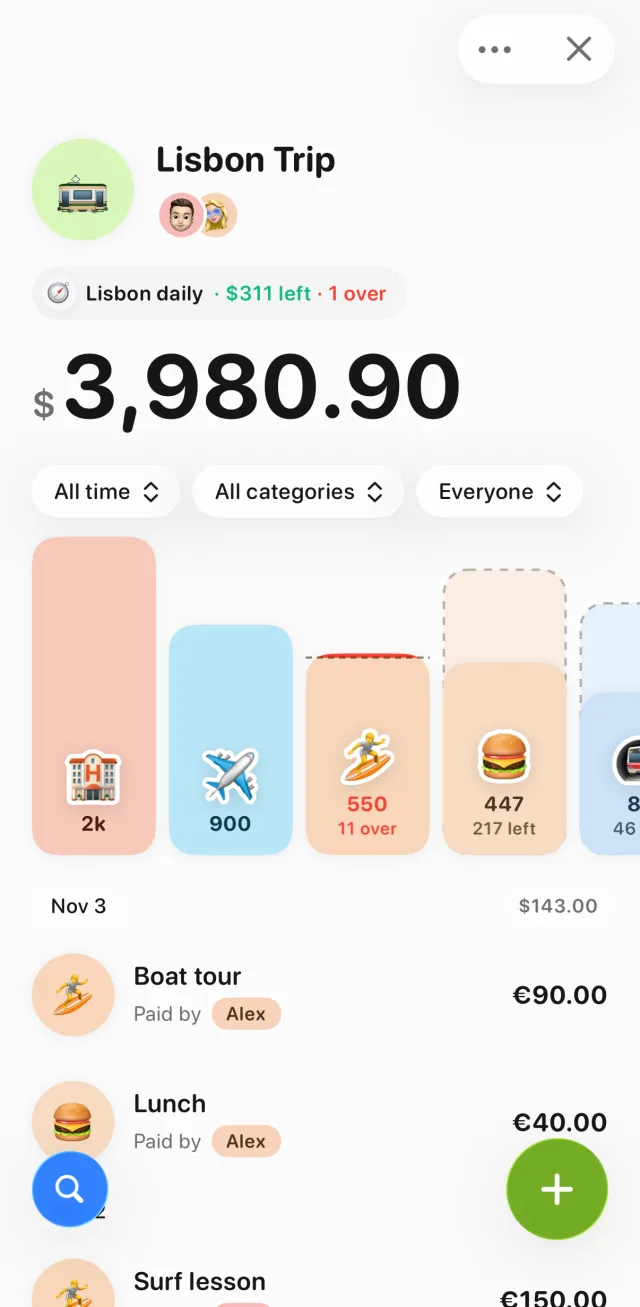
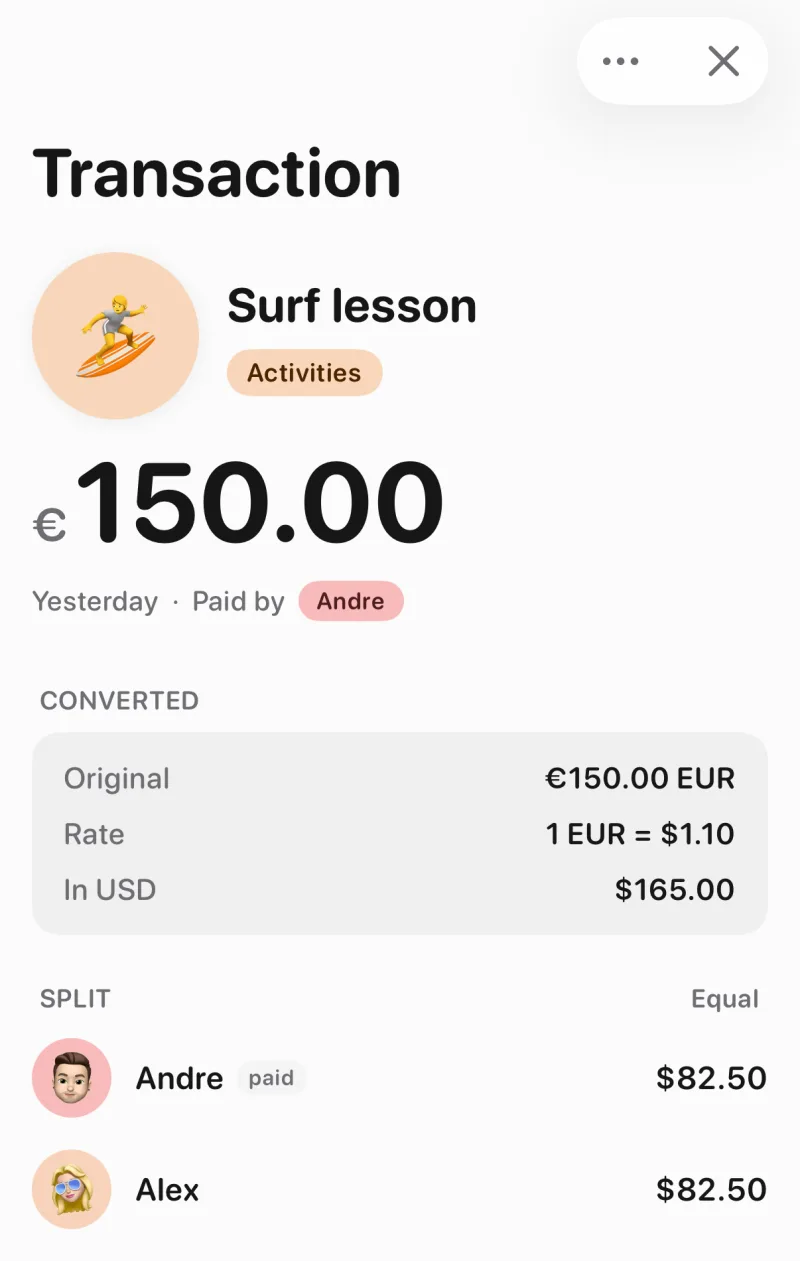
Log in euros, see dollars. Each bill can be in its own currency. Tally converts it to the trip's base currency with the rate locked at the moment you enter it, so the numbers don't shift later. Exchange rates refresh in Settings. Tally uses the latest exchange rates it has downloaded, so the result won't exactly match what your bank charges (and it doesn't know about card fees). That's what the buffer is for.
A budget for the daily categories. In Tally, a budget is a named set of limits, one per category, that you attach to an expense. For a trip, a neat setup is to cap only the pay-as-you-go categories: here, Food $440, Local transport $88, Activities $264 and Extras $88, for $880 in total. The flight and the apartment, already paid, show under "Not in this budget," so they don't make the daily spending look out of control.
On a trip with start and end dates, the budget page paces your spending against those dates. It shows what's left and how many days remain, spent against limit for each category (red when one goes over), and, once you have a few days of spending, a forecast line with a one-sentence verdict. On a shared trip, the budget counts only your share of each bill, so it's your personal trip budget even when a friend paid.
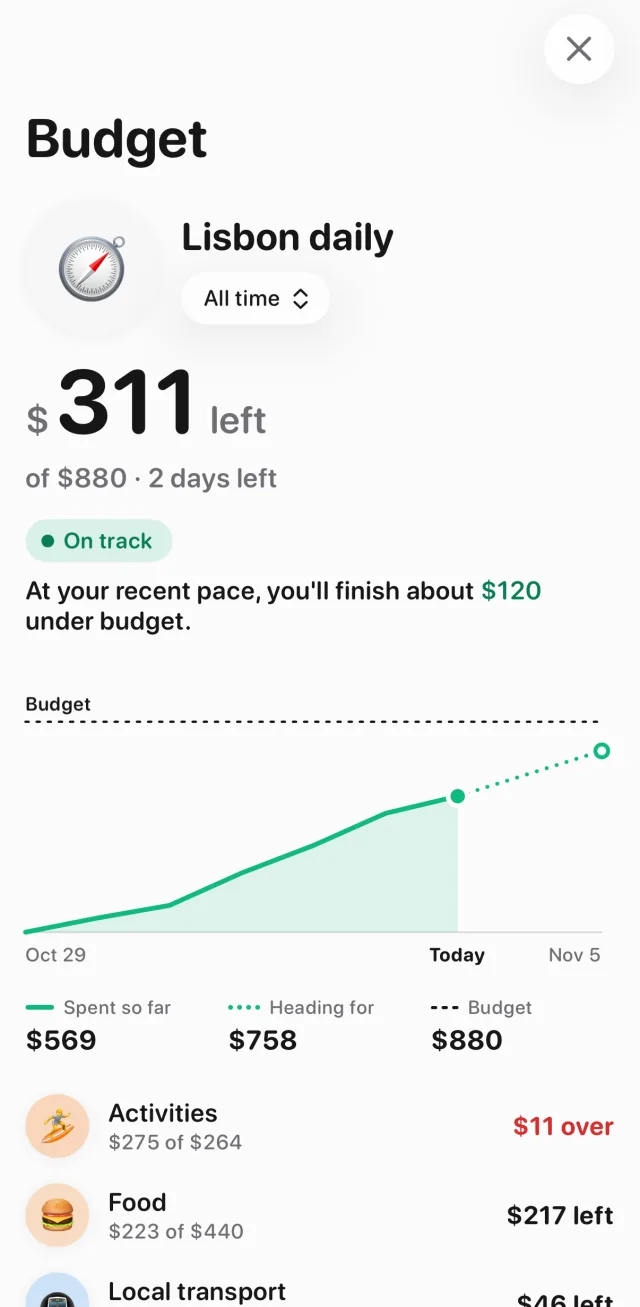
The forecast is Tally's estimate from your recent daily spending, not a promise: in this example it projects you'll end around $758, about $120 under the $880. That's the same as assuming you keep spending at your average so far for the last 2 days. In the first few days, before there's enough spending to forecast from, it shows the daily amount that keeps you on budget instead.
On the free plan you can create up to 5 expenses and 2 budgets, so a trip budget fits alongside an everyday one. Tally doesn't connect to your bank, so purchases are entered by hand, and card fees only appear if you log them. If you're traveling with friends, the same expense also works out who owes whom at the end; the travel expenses guide shows how settling up works.

Tally: expense tracker and bill splitter
Log what you spend, split bills with friends in any currency, and see who owes whom when it's time to settle up. Set category budgets and watch them as you go. Free to start.

Common questions
How do I calculate a budget for a trip?
Add up the costs you book ahead (transport and lodging, from real quotes) and the costs you pay on the ground (food, local transport, activities and extras, estimated per day and multiplied by the number of days). Add a buffer for surprises and fees.
How much should I budget per day for a trip?
It depends on the destination and how you travel, so build it yourself: pick a daily amount for food, local transport, activities and extras based on real prices where you're going, then add them up. In the example above, that's €50 + €10 + €30 + €10 = €100 a day.
How big should a trip budget buffer be?
There's no official number. The example uses 10% of the total as a round figure. What matters is having a separate line for surprises, so one unexpected cost doesn't wreck the whole plan.
How do I budget for currency exchange and fees?
Convert every foreign cost at one planning rate, then check your bank's and card issuer's fees before you go. Multiply your foreign spending by any foreign transaction fee rate, and include ATM fees if you plan to withdraw cash.
How do I stick to a travel budget while I'm away?
Log each purchase the same day with its category. Each evening, compare your total with the plan so far, look at which category is running over, and divide the money left by the days left to get your new daily budget.