
How to Split a Restaurant Bill (Tax, Tip and Who Had What)
There are three ways to split a bill at a restaurant: evenly, by what each person ordered, or a hybrid where everyone pays for their own dishes and the shared plates and bottles are divided among the people who shared them. For tax and tip, the fair rule is the same every time: each person pays the same fraction of tax and tip as their fraction of the food and drink subtotal.
The quickest way to do that is one division. Divide the final total (with tax and tip) by the subtotal, then multiply each person's subtotal by that number.
The short version: split evenly when orders are close. When they aren't, add up each person's own items plus their part of anything shared. Divide the final total by the subtotal to get a multiplier, and multiply each person's subtotal by it. Round to the cent, check that the shares add up to the bill, and let one card pay while everyone else pays that person back.
With Friendsgiving and holiday dinners coming up, here is the whole thing on one bill, with numbers that add up to the cent. The amounts are made up and the method works in any currency.
The three ways to split a check
| Method | How it works | Best when |
|---|---|---|
| Evenly | Total ÷ people | Orders are close |
| By order | Each pays for their own items | Nothing was shared |
| Hybrid | Own items, plus a part of shared ones | Most group dinners |
Decide which one you're using before you order if you can. The guide to splitting bills with friends covers how to bring it up; this post is about the math once the check lands.
The example bill
Four friends go out for a Friendsgiving dinner: you, Alex, Sam and Jo.
- Two appetizers for the table: $24, shared by all four
- A bottle of wine: $36, shared by you, Alex and Jo (Sam didn't drink)
- Mains: you $26, Alex $32, Sam $22, Jo $20
- Subtotal: $160.00
- Tax (8% in this example): $12.80
- Tip (20% of the subtotal, this table's choice): $32.00
- Total: $204.80
Use the tax printed on your own check, and whatever tip your table agrees on. More on the tip below.
Way 1: Split it evenly
$204.80 ÷ 4 = $51.20 each.
That takes ten seconds, and it's the right call when everyone ate and drank about the same. Here it isn't quite: Sam had the cheapest main and no wine, and would pay the same as Alex, who had the most expensive main and a third of the bottle.
Way 2 and 3: By order, with shared items divided
First, work out each person's subtotal: their own items, plus their part of anything shared.
- Appetizers: $24 ÷ 4 people = $6 each
- Wine: $36 ÷ 3 drinkers = $12 each
| Friend | Own | Shared | Subtotal |
|---|---|---|---|
| You | $26 | $6 + $12 | $44 |
| Alex | $32 | $6 + $12 | $50 |
| Sam | $22 | $6 | $28 |
| Jo | $20 | $6 + $12 | $38 |
| Total | $100 | $60 | $160 |
If nothing was shared, the Shared column is empty and you're splitting purely by order. Add shared plates and you have the hybrid. Either way, check that the subtotals add up to the subtotal on the check ($160) before going on.
The math for tax and tip
Tax and tip are both based on what was ordered, so the fair way to share them is in proportion: someone with 25% of the subtotal pays 25% of the tax and 25% of the tip.
You don't have to work out tax and tip separately for each person. One number does both:
Multiplier = final total ÷ subtotal
Here that's $204.80 ÷ $160 = 1.28. Multiply each person's subtotal by it:
| Friend | Subtotal | Tax and tip | Pays |
|---|---|---|---|
| You | $44 | $12.32 | $56.32 |
| Alex | $50 | $14.00 | $64.00 |
| Sam | $28 | $7.84 | $35.84 |
| Jo | $38 | $10.64 | $48.64 |
| Total | $160 | $44.80 | $204.80 |
Checking the arithmetic: $56.32 + $64.00 + $35.84 + $48.64 = $204.80, the total on the check. And the tax and tip column adds up to $12.80 + $32.00 = $44.80.
Compared with the even split of $51.20, Sam pays $15.36 less and Alex pays $12.80 more. That gap is the reason to itemize. If the gap at your table is a dollar or two, split evenly and enjoy the evening.
The same thing as percentages
Another way to see it: each person's share of the subtotal is their share of everything.
- You: $44 ÷ $160 = 27.5%
- Alex: $50 ÷ $160 = 31.25%
- Sam: $28 ÷ $160 = 17.5%
- Jo: $38 ÷ $160 = 23.75%
Those add up to 100%, and 27.5% of $204.80 is $56.32, the same answer as before. This is handy if you'd rather not work out anyone's tax and tip at all.
How much to tip, and on which number
That's the table's call, and tables differ. In a Pew Research Center survey of 11,945 US adults in August 2023, 57% said they would tip 15% or less for an average sit-down meal, and a quarter said 20% or more. So don't assume everyone has the same number in mind. Say it out loud: "20% okay with everyone?"
Two more things to settle:
- Before or after tax? A tip can be a percentage of the subtotal or of the total with tax. Neither is wrong. In the example, 20% of the $160 subtotal is $32.00, and 20% of the $172.80 after tax would be $34.56. Pick one as a group.
- Is a tip already on the check? Some restaurants add a gratuity or service charge themselves, especially for big tables. The IRS lists a "large dining party automatic gratuity" among the charges commonly added to a customer's check. Read the bill before adding a tip on top.
Whatever you decide, the multiplier still works, because it uses the final total you actually pay.
Rounding: what to do with the stray cent
The example lands on whole cents. Most bills don't. Say the same table leaves a flat $30 tip instead. The total is $202.80 and the multiplier is $202.80 ÷ $160 = 1.2675.
| Friend | Exact share | Rounded |
|---|---|---|
| You | $55.77 | $55.77 |
| Alex | $63.375 | $63.38 |
| Sam | $35.49 | $35.49 |
| Jo | $48.165 | $48.17 |
| Total | $202.80 | $202.81 |
Rounding each share to the nearest cent gives a total one cent too high. The fix: round everyone, add the shares up, and move the leftover cent or two onto one person until the total matches the check. The simplest rule is that whoever put their card down takes the difference. If that's you, you pay $55.76, and the four shares add up to exactly $202.80.
When friends pay you back, many groups round to the nearest dollar instead ($64, $36 and $49). That's fine too, as long as it's a choice and not an accident.
Shared plates, non-drinkers, birthdays and other special cases
Shared appetizers and bottles
Divide each shared item among the people who actually had some, not the whole table. In the example the appetizers are split four ways and the wine three ways. A dessert two people shared is split in two.
Don't try to measure who ate more of the nachos. Equal parts among the sharers is close enough, and it keeps dinner friendly.
Someone who didn't drink
Drinks are often the biggest gap on a check. If you don't want to itemize the whole bill, there's a lighter hybrid: take the alcohol out, split it among the drinkers, and split everything else evenly.
- Wine with its tax and tip: $36 × 1.28 = $46.08, or $15.36 for each of the three drinkers.
- Everything else: $204.80 minus $46.08 is $158.72, or $39.68 for each of the four.
So you, Alex and Jo pay $39.68 + $15.36 = $55.04 each, and Sam pays $39.68. Check: 3 × $55.04 + $39.68 = $204.80.
A birthday guest whose share is covered
Say it's Jo's birthday and the other three are treating her. Work out the bill as usual, then divide Jo's share among the rest:
- Jo's share: $48.64 ÷ 3 = $16.2133..., so $16.21 each, with one cent left over
- You (the card holder, taking the extra cent): $56.32 + $16.22 = $72.54
- Alex: $64.00 + $16.21 = $80.21
- Sam: $35.84 + $16.21 = $52.05
- Jo: $0
Check: $72.54 + $80.21 + $52.05 = $204.80.
If you were splitting evenly anyway, it's simpler still. Leave Jo out and divide by three: $204.80 ÷ 3 gives $68.27, $68.27 and $68.26.
One person pays by card and is paid back
This is usually the easiest way to get out of the restaurant. One person pays the full $204.80, and the others pay their shares back: Alex $64.00, Jo $48.64 and Sam $35.84. That's $148.48 coming back, which leaves the payer covering exactly their own $56.32.
Two habits help. Take a photo of the itemized receipt before it leaves the table, and send everyone their number that night, while people still remember who had the second appetizer.
Asking the server for separate checks
Separate checks skip the math completely, with a few catches:
- Ask when you sit down, not when the check arrives. It's much easier for a server to split a table from the start.
- Not every restaurant will do it, especially for a big group, so have a backup plan (one card and a payback).
- Say where the shared items go. "Appetizers split four ways, the wine on these three" saves a correction later.
- Each check gets its own tip, so everyone chooses their own.
Another option is asking the server to split one check across several cards, either evenly or with a set amount on each. Work out the amounts first with the table above, then hand over the cards with the numbers.
How to split a restaurant bill in Tally
Tally keeps the bill, who paid and each person's share in one place, and then tells everyone what they owe. The screenshots below were made in Tally's demo mode with the numbers from this post.
1. Create an expense for the dinner and add people by name. Tap Add person for each friend. They don't need the app or an account to be in the split.
2. Add the bill with the final total and who paid. Enter $204.80, the total with tax and tip, and pick whoever put their card down under Paid by.
3. Choose the split. Tally has three, and each fits a case from this post:
- Equal: an even split among everyone, or tap people out. For the birthday dinner split three ways, tap Jo out and Tally divides $204.80 among the other three, handing out the leftover cent for you.
- %: type each person's percentage of the subtotal (27.5, 31.25, 17.5 and 23.75). Tally shows the dollar amount under each name, tax and tip included, and the percentages need to add up to 100.
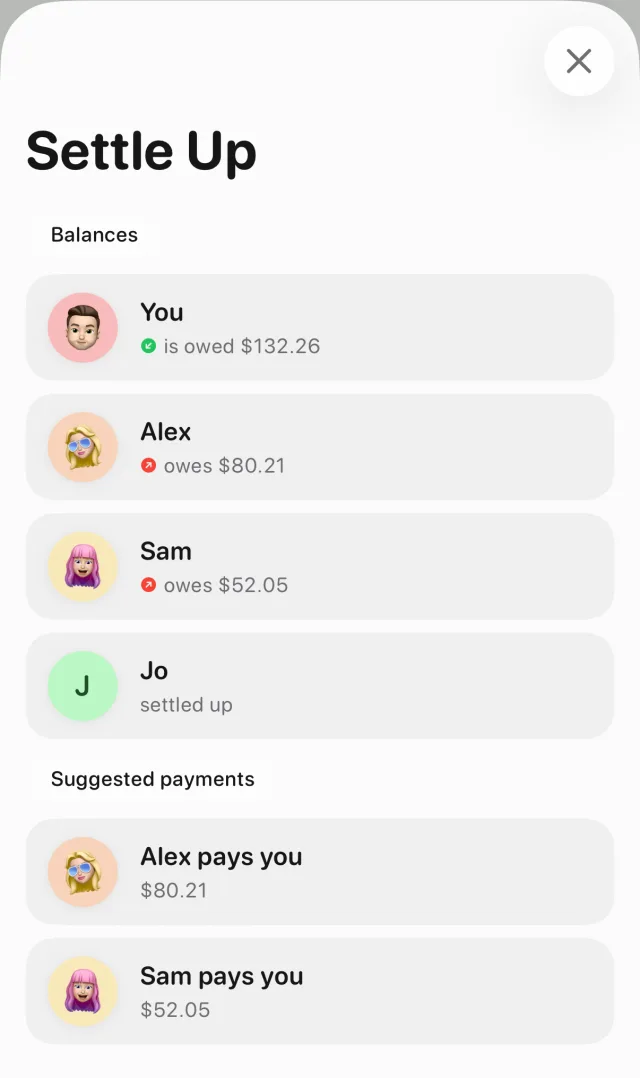
- Exact: type each person's dollar amount from your own math, like $72.54, $80.21, $52.05 and $0 for the covered birthday. Tally shows how much is left to assign and won't save until the amounts add up to the bill.
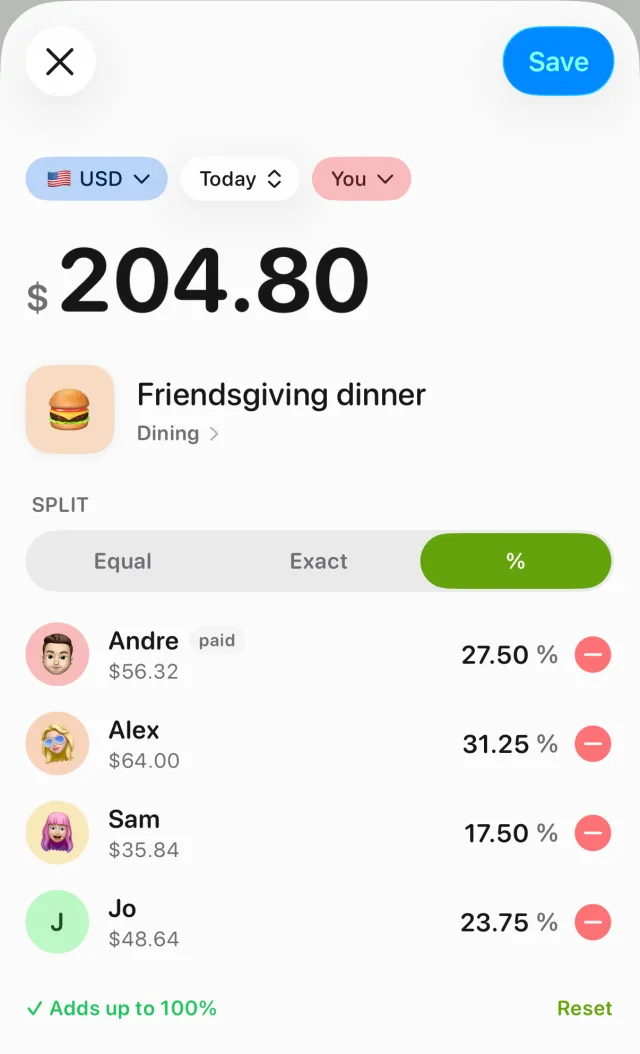
If your percentages come out as long decimals (a third of the bill is 33.33...%), use Exact amounts instead, since typed percentages have to reach 100.
Here is the covered birthday entered as exact amounts, with Jo at $0:
For the lighter hybrid, log two bills with the Equal split: the wine ($46.08) with Sam tapped out, and everything else ($158.72) with all four in.
4. Open Settle Up. It shows each person's balance and a short list of suggested payments that brings everyone to zero.
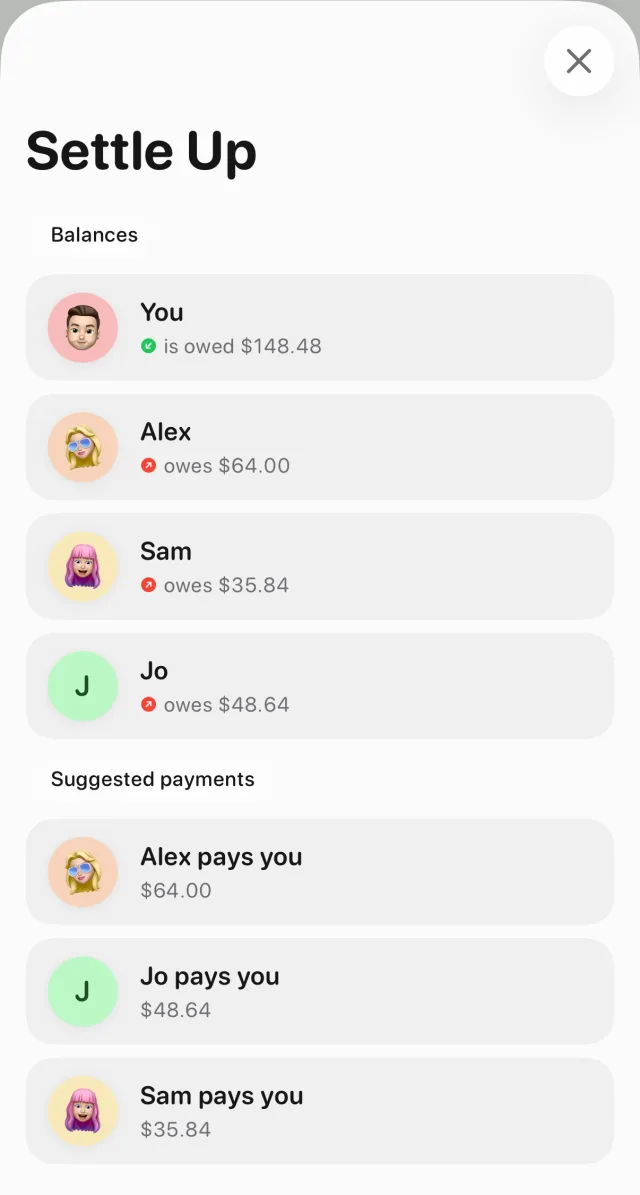
Tally shows who pays whom; you send the money yourselves however you usually do. Each bill has one payer, so if two people each put a card down, log it as two bills.
If the holidays mean several shared meals, keep them in one expense and settle once at the end. And if you're keeping a holiday budget, only your own share of the dinner ($56.32 here, not the $204.80 on your card) counts against it. For dinners on a trip abroad, the guide to splitting travel expenses covers bills in other currencies.
Splitting and Settle Up are in the free plan, which includes up to 5 expenses you create and 2 budgets. Tally+ removes the caps.

Tally: expense tracker and bill splitter
Log what you spend, split bills with friends in any currency, and see who owes whom when it's time to settle up. Set category budgets and watch them as you go. Free to start.

Common questions
What is the fairest way to split a restaurant bill?
Each person pays for their own items, plus an equal part of anything they shared, plus tax and tip in proportion to that subtotal. When orders are close, an even split is just as fair and much faster.
How do you split tax and tip fairly?
In proportion to what each person ordered. Divide the final total by the food and drink subtotal, then multiply each person's subtotal by that number. On a $160 subtotal and a $204.80 total, the multiplier is 1.28, so a $50 order pays $64.00.
How do you split a bill when someone didn't drink?
Split the drinks only among the people who had them. Either add each drinker's part to their own subtotal, or take the drinks (with their tax and tip) out of the bill, split them among the drinkers, and split the rest evenly.
Should you split the bill evenly or pay for what you ordered?
Evenly when everyone ordered about the same, by order when there's a clear gap, such as one person skipping drinks or ordering much less. Agreeing before you order avoids the awkward moment later.
How do you split the bill when it's someone's birthday?
Work out the split as usual, then divide the birthday guest's share among everyone else. If you're splitting evenly, just divide the total by the number of people paying.
Can a restaurant split the check for you?
Often, yes, but it depends on the restaurant and the size of the group. Ask for separate checks when you sit down, and say how shared items should be divided.