
How to Make a Holiday Budget (and Stick to It Through December)
To make a holiday budget, start with one total: the amount you can spend this season without borrowing against next year. Split that total into categories (gifts, food and hosting, travel, decorations, events, giving, and the small extras like shipping and wrapping), then give every person on your gift list a number. Track each purchase against its category from the first gift to New Year's, and review what happened in January.
The short version: add up what you've set aside plus what you can spare from your November and December pay. That's the total. Divide it into 6 to 8 categories, with gifts broken down person by person. Log every purchase the same day and check which category is running hot. Split shared costs (a Friendsgiving, a group gift) as you go, and in January, turn the final numbers into next year's plan.
This post is about the method and the arithmetic, not financial advice. The numbers in the example are round and made up to keep the math easy to follow, and the method works in any currency.
Step 1: Set one total from what you can afford
The most common way to pick a holiday number is to look at last year and add a bit. That works only if last year was affordable. If part of last December was still on a card in March, last year's total is a warning, not a target.
A sturdier way is to build the total from money you actually have:
- What's already set aside. A holiday fund, a savings pot, cash you've put away.
- What you can spare from your November and December pay. Look at what's left after your regular bills and everyday spending, and decide how much of that can go to the holidays.
Add the two, and that's your holiday budget. In the example below, $700 is already saved, and $400 can come from each of the two months: $700 + $400 + $400 = $1,500.
You're not alone in letting the budget lead. In the National Retail Federation's 2026 holiday survey, 56% of holiday shoppers said the state of the economy will affect their holiday spending plans, and among people starting their shopping before November, 50% said they do it to spread out their holiday shopping budgets.
Step 2: Split the total into categories
One big number is hard to stick to. Seven smaller ones are easier, because you can see exactly which part is running over. Most holiday spending fits into these:
- Gifts. Usually the biggest line. In NRF's 2025 survey, people planned to spend $890.49 per person on average on the holidays, and $627.93 of that was for gifts for family and friends.
- Food and hosting. Groceries for the big meals, baking, your share of potlucks, a host gift when you're the guest.
- Travel. Flights, train or gas to get home, parking, a ride to the airport.
- Decorations. A tree, lights, a wreath, candles. Often bought once and reused, but there's always something new.
- Events and outfits. The office party, a holiday show, a new sweater for the family photo.
- Giving. Donations, a toy drive, tips for the people who help you all year.
- Hidden extras. Shipping, wrapping paper, tape, cards and stamps, batteries for the toys. Each is small, together they add up.
If you already keep a monthly budget, the holidays can be their own small budget for the season rather than one "Gifts" line. The budget categories list covers the everyday categories; this post is about the season.
Step 3: Make the gift list, person by person
"Gifts: $600" is a guess. A list with a name and a number next to each person is a plan, and it's the one part of the budget you can check in the store.
Write down everyone you'll buy for, including the easy-to-forget ones: teachers, a work gift swap, a host. Then give each a number and make sure the list adds up to the gifts line.
| Who | Budget |
|---|---|
| Partner | $150 |
| Mom and Dad (your third of a $240 shared gift) | $80 |
| Sister | $60 |
| Brother-in-law | $40 |
| Two nieces, $50 each | $100 |
| Grandma | $40 |
| Two teachers, $15 each | $30 |
| Work gift swap | $25 |
| Three friends, $25 each | $75 |
| Total | $600 |
Checking the arithmetic: $150 + $80 + $60 + $40 + $100 + $40 + $30 + $25 + $75 = $600, exactly the gifts line.
If the list comes out higher than the line, you have three options: lower some numbers, take people off the list (a family gift swap or a "kids only" rule helps here), or move money from another category. Moving money is fine, as long as the total stays the same.
A worked example: a $1,500 holiday budget
Here's the whole budget for the example, with the gift list above as its biggest line:
| Category | What's in it | Budget |
|---|---|---|
| Gifts | The list above | $600 |
| Food and hosting | Big meals, baking, Friendsgiving share | $300 |
| Travel | Flights home, airport ride | $250 |
| Events and outfits | Office party, a show, one new outfit | $100 |
| Hidden extras | Shipping, wrapping, cards, stamps | $100 |
| Decorations | Lights, a wreath, candles | $75 |
| Giving | Food bank, toy drive, tips | $75 |
| Total | $1,500 |
Checking the arithmetic: $600 + $300 + $250 + $100 + $100 + $75 + $75 = $1,500, the same total from Step 1.
There's no separate buffer line here on purpose. The hidden extras line is set on the generous side, so it can soak up small surprises too. If you'd rather keep a buffer as its own line, take it out of the total before you split, not on top of it.
Step 4: Track it as you spend, from November to New Year's
A holiday budget that lives on a sticky note tells you on December 26 that you went over. Tracking as you go tells you in early December, when you can still swap the second gift for a card.
The habit is the same one from how to track your spending, applied to one season:
- Log each purchase the same day, with its category and, for gifts, who it's for.
- Check the category, not just the total. Being under overall can hide a gifts line that's already gone.
- Count shipping and returns. Log shipping in hidden extras when you pay it, and subtract a refund when it arrives.
- Look again before the big shopping days. NRF's 2026 survey found 64% of consumers are likely to wait until Thanksgiving weekend to do most of their shopping, so that's a good moment to check what's left in each line.
Here's the example on November 12, eleven days into the season:
| Category | Budget | Spent | Left |
|---|---|---|---|
| Gifts | $600 | $117 | $483 |
| Food and hosting | $300 | $0 | $300 |
| Travel | $250 | $238 | $12 |
| Events and outfits | $100 | $0 | $100 |
| Hidden extras | $100 | $12 | $88 |
| Decorations | $75 | $24 | $51 |
| Giving | $75 | $25 | $50 |
| Total | $1,500 | $416 | $1,084 |
Travel is nearly gone because the flights are booked, and that's fine: it was planned. Gifts have $483 left for 7 of the 9 lines on the list (the nieces and sister are done). Nothing has gone over, and you know exactly where the remaining $1,084 is meant to go.
Step 5: Split shared costs as they happen
Holiday costs are often shared, and shared costs are where budgets get fuzzy. The fix is to count only your share against your budget, and to work out who owes whom before everyone scatters.
A Friendsgiving. Five friends: you buy the turkey and groceries for $150, and Alex brings wine and drinks for $50. The meal cost $200, so each person's share is $200 ÷ 5 = $40. Your food and hosting line goes up by $40, not $150. As for the money: you paid $110 more than your share and Alex paid $10 more, while Sam, Jo and Riley each owe $40. Four payments clear it: Sam and Jo each pay you $40, Riley pays you $30 and pays Alex the last $10.
A shared gift. Three siblings chip in for a $240 gift for their parents. Your sister buys it, so you and your brother each owe her $80. That $80 is the "Mom and Dad" line in the gift list above.
Agree on how you'll split before anyone shops: equal shares, or a different amount for someone who's bringing more. The guide to splitting bills with friends covers uneven splits and how to ask for money without the awkwardness. If you're traveling to see family, the trip budget guide covers lodging and daily costs in more detail.
Step 6: Review in January
The holiday budget pays off twice: once in December, and again when you look back at it. In the first week of January:
- Compare each category with its budget. Which went over, which came in under?
- Find the reason. A gift that cost more than planned, a trip that needed a hotel, ten extra cards.
- Settle anything still open from shared costs, so it doesn't drift into February.
- Set next year's number now. Divide next year's total by 12 and you know what to set aside each month. In the example, $1,500 ÷ 12 = $125 a month, which turns December into a planned cost instead of a surprise.
Making a holiday budget in Tally
Tally holds the whole plan: the season, the category limits, the purchases as they happen, and the shared costs with friends. The screenshots below were made in Tally's demo mode with the numbers from this post.
A budget with one limit per category. In Tally, a budget is a named set of spending limits, one per category, with the total adding up as you type. Categories are your own, with your names, colors and emojis, so "Food & hosting" or "Extras" can sit right next to Gifts and Travel.
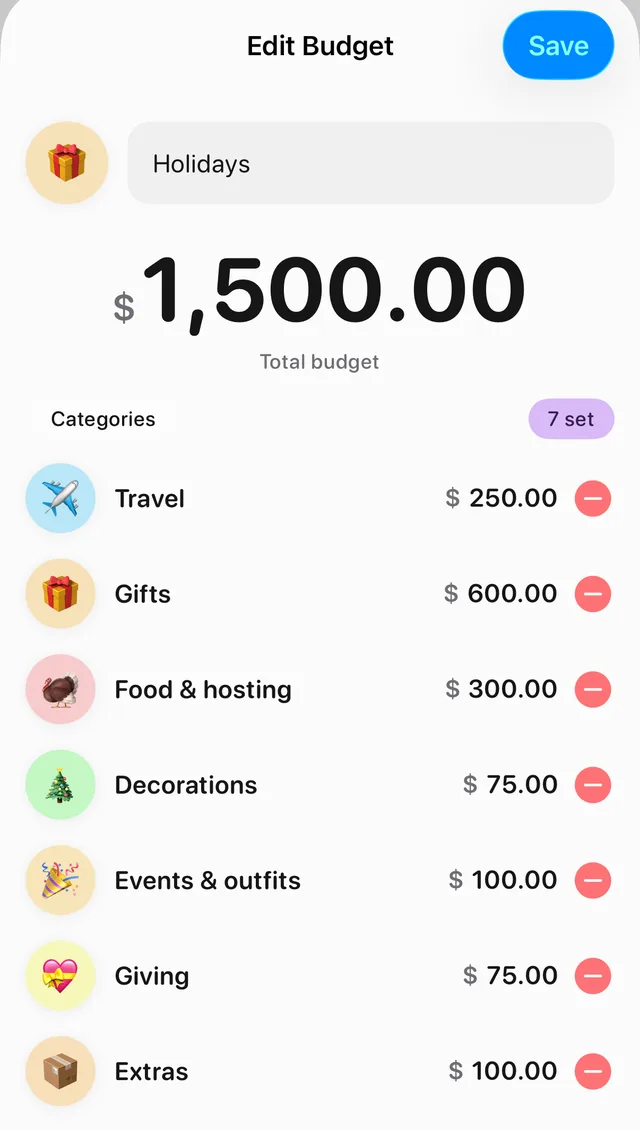
One expense for the season. Create an expense called "Holidays," give it a start and an end date (here, November 1 to December 31), and attach the budget. Then log each purchase with its category as you buy it. The budget page shows what's left and how many days remain, spent against limit for each category (red if one goes over), and a pace chart with a forecast once you have a few days of spending.
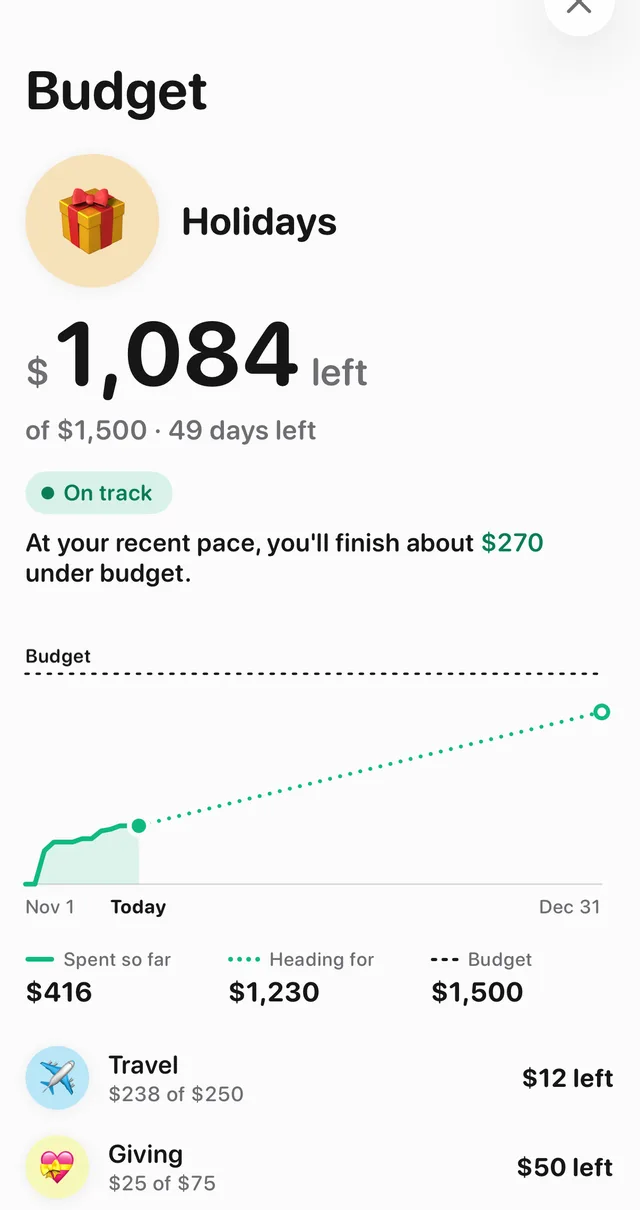
The forecast extends your recent daily spending to the end of the season, so treat it as a check, not a promise. If most of your shopping is still ahead, expect the verdict to move as you log the big shopping days.
Shared costs, with Settle Up. For a Friendsgiving or a group gift, create a separate expense and add your friends by name; they don't need the app. Log each bill with who paid and split it equally, by exact amounts or by percentages. Settle Up then shows each person's balance and a short list of suggested payments that clears everyone.
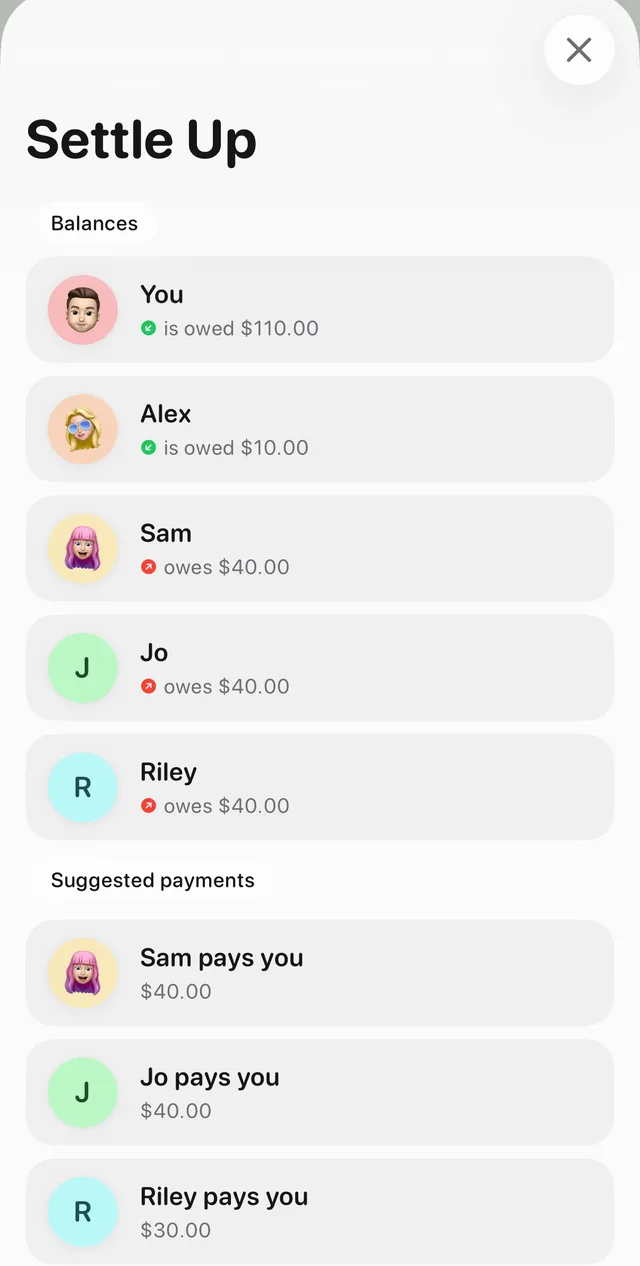
Tally shows who pays whom; you send the money yourselves however you usually do. And if you attach a budget to a shared expense, it counts only your share of each bill: a $150 grocery run split five ways counts as $30 against your limit, not $150.
The free plan includes up to 5 expenses you create and 2 budgets, enough for a Holidays expense with its budget, a Friendsgiving and a shared gift. Tally doesn't connect to your bank, so purchases are entered by hand, which also means every one gets a category the moment you log it. Tally+ removes the limits.

Tally: expense tracker and bill splitter
Log what you spend, split bills with friends in any currency, and see who owes whom when it's time to settle up. Set category budgets and watch them as you go. Free to start.

Common questions
How much should I budget for Christmas?
Build it from what you can afford: what you've already set aside plus what you can spare from your November and December pay after regular bills. That number is your total, whatever anyone else spends.
What should a holiday budget include?
Gifts (broken down by person), food and hosting, travel, decorations, events and outfits, giving, and the hidden extras: shipping, wrapping, cards and stamps.
How do I keep my holiday spending on budget?
Log each purchase the same day with its category, check categories rather than just the total, and look again before the big sale weekends. When one line runs over, move money from another line instead of raising the total.
How do I split holiday costs with family or friends?
Agree on the split before anyone shops, have one person pay each bill, write down who paid, and count only your share against your own budget. Settle everything once at the end instead of after every purchase.
When should I start saving for next year's holidays?
In January. Divide next year's total by 12 and set that amount aside each month, so the holidays arrive already paid for.