
How to Split Bills With Friends (and Work Out Who Owes Who)
To split bills with friends, let one person pay each bill and write down who paid. Split it among only the people who took part. When it's time to settle, work out each person's balance (what they paid minus their share), then have the people who owe pay the people who are owed.
That one idea, the balance, turns a messy month of dinners and tickets into two or three payments. Here's how to do it, with the math worked through.
The short version: split equally by default. Use exact amounts when orders are very different, and leave out anyone who wasn't part of a cost. Add up what each person paid and what their share was. The difference is their balance. Match the people who owe with the people who are owed, and a group never needs more payments than its number of people minus one.
Pick the right split for each bill
Most friend-group costs fall into a few familiar patterns.
| Situation | A fair split |
|---|---|
| Dinner, similar orders | Equal |
| Dinner, uneven orders | Each person's order, plus their part of tax and tip |
| Someone skipped the drinks | Drinks split only among the people drinking |
| Concert or event tickets | Equal among the people going |
| Gift for a friend | Equal among the givers, leaving out the friend |
| Weekend away | Equal among the people staying, or by nights |
Decide before the bill shows up if you can. "Should we just split it evenly?" is an easy question before you order and an awkward one after someone has had the lobster.
When orders are uneven
If orders are close, an equal split saves everyone the trouble. If they aren't, the fair way to handle tax and tip is proportionally: whoever ordered more pays more of them too.
Divide the final bill by the food and drink total, then multiply each order by that number. Say four friends order $96 of food and drinks, and tax and tip bring the bill to $120. That's $120 ÷ $96 = 1.25, so each order gets multiplied by 1.25:
| Friend | Order | With tax and tip |
|---|---|---|
| You | $32 | $40 |
| Alex | $28 | $35 |
| Sam | $20 | $25 |
| Jo | $16 | $20 |
| Total | $96 | $120 |
The same trick works in any currency, and a phone calculator handles it in seconds. If a split leaves a stray cent, someone rounds up and nobody needs to mention it again.
When one person pays
Having one card cover the bill is usually easiest, whether it's a table of eight or tickets that go on sale at 10 a.m. It only works if someone writes it down right away: what it was, how much, who paid, and who's in on it.
Take turns when you can, so the same friend isn't always floating the group. If someone fronts a big cost like tickets months ahead, it's kind to settle that one early rather than leaving them out of pocket until the show.
How to work out who owes who
Here's a realistic month for four friends: a dinner with the uneven orders from above, concert tickets, a birthday gift for Jo, and a cabin weekend.
| Bill | Paid by | Amount | Split |
|---|---|---|---|
| Dinner | Alex | $120 | By order |
| Concert tickets | You | $160 | All four |
| Gift for Jo | Sam | $165 | All but Jo |
| Cabin | You | $400 | All four |
| Cabin groceries | Jo | $72 | All four |
| Total | $917 |
Each person's share comes from the Split column. The tickets are $40 each, the gift is $55 each for three people, the cabin is $100 each and the groceries are $18 each, plus each person's part of the dinner. Jo pays nothing toward the gift.
For example, your share is $40 (dinner) + $40 (tickets) + $55 (gift) + $100 (cabin) + $18 (groceries) = $253. You paid $160 + $400 = $560. So your balance is $560 minus $253, and you're owed $307.
Do that for everyone:
| Friend | Paid | Share | Balance |
|---|---|---|---|
| You | $560 | $253 | is owed $307 |
| Alex | $120 | $248 | owes $128 |
| Sam | $165 | $238 | owes $73 |
| Jo | $72 | $178 | owes $106 |
| Total | $917 | $917 |
Two quick checks catch most counting mistakes. Total paid must equal total shares ($917 both ways), and what's owed must equal what's owing ($128 + $73 + $106 = $307). If either one is off, a bill got counted wrong.
How to get down to the fewest payments
Counted bill by bill, this month creates 14 separate IOUs, such as Sam owing Alex $25 for dinner while Alex owes Sam $55 for the gift.
Netting each pair of friends brings that down to six payments:
- Alex pays you $100
- Sam pays you $85
- Jo pays you $122
- Alex pays Sam $30
- Sam pays Jo $18
- Jo pays Alex $2
Nobody wants to send someone $2. Netting the whole group instead brings it down to three:
- Alex pays you $128.
- Jo pays you $106.
- Sam pays you $73.
Everyone ends at zero, and all the cross-debts between Alex, Sam and Jo vanish, because the balance already accounts for them.
When more than one person is owed
In that example only one person is owed, so the matching is obvious. When there are two or more, use these steps:
- List the balances. Separate the people who owe from the people who are owed.
- Look for exact matches first. If someone owes exactly what someone else is owed, pair them. That's one person finished on each side.
- Match the largest with the largest. Have the biggest debtor pay the biggest creditor as much as they can, then repeat with what's left.
Here's why step 2 matters. Say five friends have these balances: Mia is owed $40 and Ben is owed $30, while Cara owes $30, Dev owes $20 and Eli owes $20.
Going straight to largest with largest gives four payments: Cara pays Mia $30, Dev pays Ben $20, Eli pays Ben $10, and Eli pays Mia $10.
Spot the exact match (Cara owes $30, Ben is owed $30) and it takes three: Cara pays Ben $30, Dev pays Mia $20, and Eli pays Mia $20. Mia gets her $40 and Ben gets his $30 either way.
How to ask for money without the awkwardness
Most of the discomfort comes from vagueness: nobody's sure of the amount, or it feels like one person is keeping score. A clear number and a clear reason take care of most of it.
Agree up front. "I'll get the tickets, you can all pay me back when we settle up" is a much easier sentence before you buy than after.
Send it soon, while it's fresh. A message the morning after the cabin feels routine. The same message six weeks later feels like a grievance.
Give the number, the reason and how to pay. Something like this:
"Cabin weekend math is done! You owe me $128 and then we're all square. Whenever you get a chance this week, thanks!"
Share the whole picture. When everyone can see the same list of bills, your message is just passing along the math.
Nudge once, plainly. People forget, and that's usually all it is:
"Hey, did the $128 from the cabin go through? I don't think I've seen it."
Be flexible when someone's short. If a friend says it's a tight month, offer a later date or two smaller payments. Your friendship will outlast the $128.
If you're the one who owes, just pay. Pay when you see the message, and your friend never has to send the second one.
How to do all this in Tally
Tally takes the arithmetic off your hands: you log each bill as it happens, and the balances and payments stay up to date on their own.
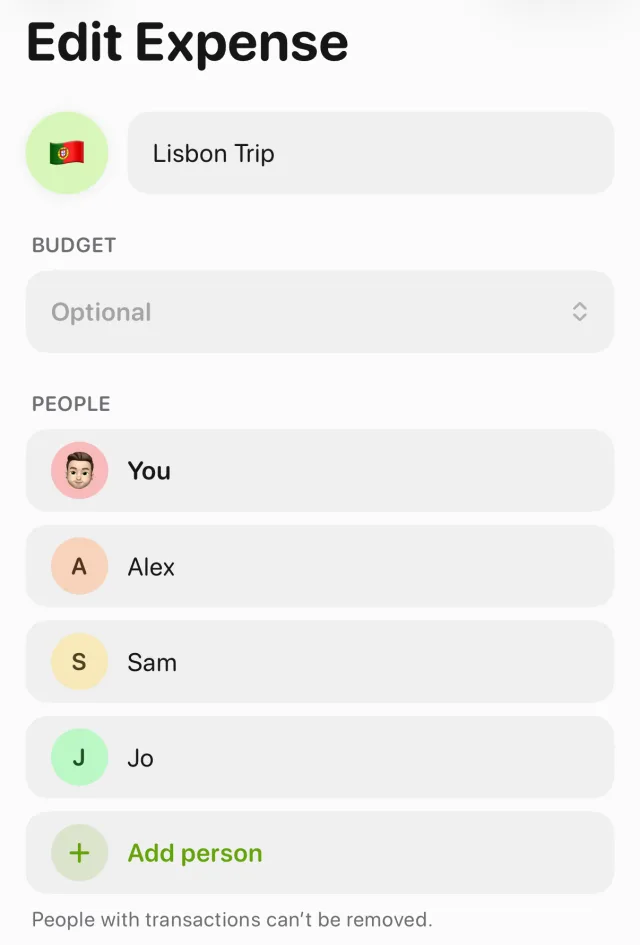
1. Create one expense and add people by name. Name it for the event or the group, then tap Add person. Friends don't need the app or an account to be in the split.
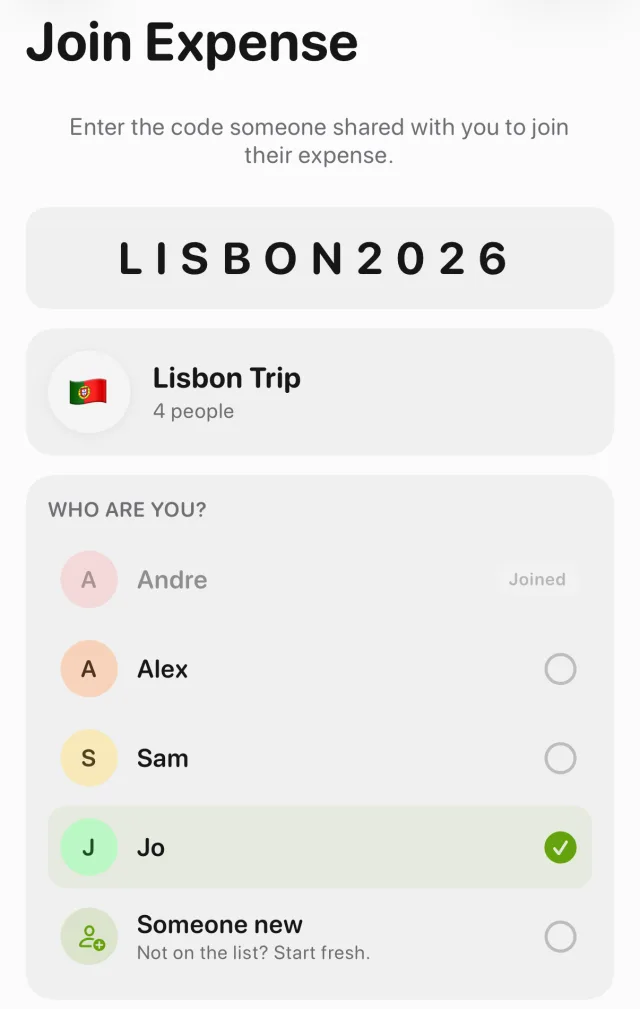
2. Invite friends with the join code. Invite People shares a message with the code. A friend signs in, types it, picks their name under "Who are you?" and can then add the bills they pay. The code expires after 14 days, and whoever created the expense can make a new one. Members see that expense, not your other expenses, budgets or email.
Joining does need an iPhone, but anyone can stay in the split by name while someone else logs their bills. That friend won't see the expense themselves, so send them their number.
3. Log each bill with who paid and how to split it. Three split methods cover the patterns above:
- Equal: tap people in or out. For Jo's gift, tap Jo out.
- Exact amounts: for the uneven dinner, enter $40, $35, $25 and $20.
- Percentages: say three friends agree to cover a gift at 40%, 40% and 20%.
Each bill has one payer, so if two people each put down a card, log it as two bills.
4. Open Settle Up. It shows everyone's balance and a short list of suggested payments that brings the group to zero. Here's the example from above:
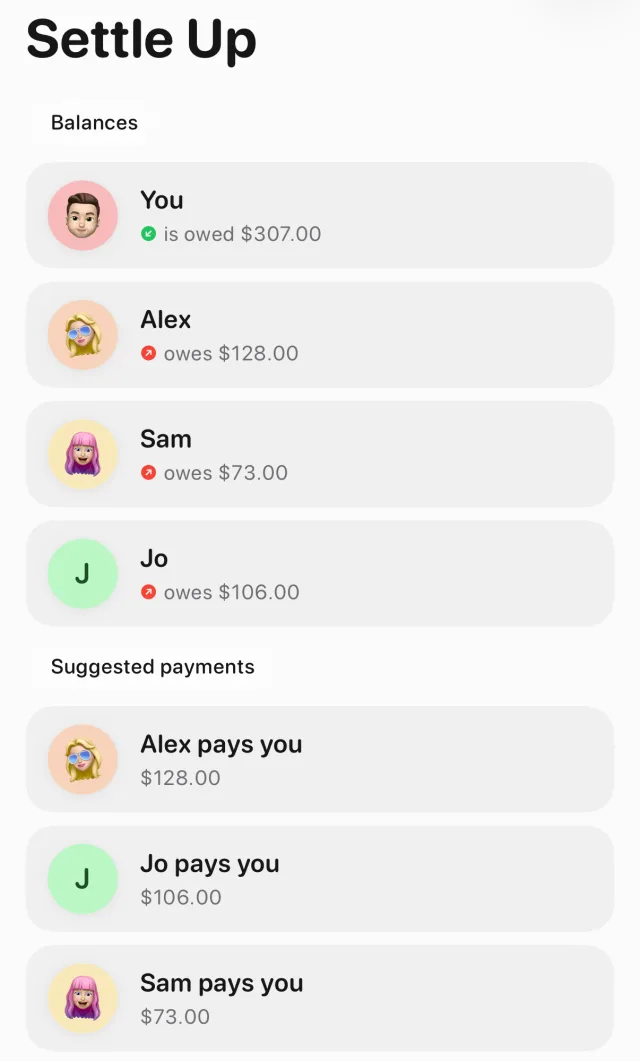
The list comes from matching the largest debtor with the largest creditor, so it's quick and short. In a case like Mia and Ben's above, you might spot an exact match that saves one more payment.
Tally shows who pays whom, and you send the money yourselves however you normally do. It doesn't move money or mark payments as settled, so the balances stay on the screen after everyone has paid. Once you're square, the creator can archive that expense, and you can start a fresh one for the next round.
Splitting and Settle Up are in the free plan, which includes up to 5 expenses you create and 2 budgets. Expenses you join don't count toward that limit, and Tally+ removes the caps.

Tally: expense tracker and bill splitter
Log what you spend, split bills with friends in any currency, and see who owes whom when it's time to settle up. Set category budgets and watch them as you go. Free to start.

If your group's situation is different
Some cases need their own approach:
- A longer trip, especially abroad: see how to split travel expenses with friends, which covers foreign currency and exchange rates.
- People you live with: see how to split bills with roommates for rent, utilities and a monthly routine.
- A partner: see how to split bills as a couple for 50/50, by income and by category.
Common questions
What's the easiest way to split a bill with friends?
Have one person pay, split it equally unless orders are very different, and write it down right away. Then settle all the bills at once instead of paying each other back after every meal.
How do you figure out who owes who?
For each person, add up what they paid and subtract their share of every bill they were part of. A positive result means they're owed money, and a negative one means they owe. The results always add up to zero.
How do you split a bill when one person orders more?
Divide the final bill, with tax and tip, by the food and drink total. Then multiply each person's order by that number. Everyone pays for what they ordered, plus a proportional part of tax and tip.
What's the minimum number of payments to settle a group?
At most one fewer than the number of people with a balance. Four friends need three payments at most, and sometimes fewer when amounts match exactly.
Is it rude to ask a friend to pay you back?
No. Asking is a normal part of splitting costs. Keep it short, include the amount and what it was for, and send it soon after the event.
Is there an app to split bills with friends?
Yes. Tally lets you add friends by name or invite them with a code, log each bill with who paid and how it's split, and see who owes who on the Settle Up screen. Splitting and settling up are included in the free plan.