
How to Split a Group Gift (Without Chasing People for Money)
To split a group gift, agree on a per-person amount before anyone buys anything. Then one person buys the gift, shares the receipt, and everyone else pays that person back by a set date. Most of the chasing happens when the order is reversed: someone buys first, then tells the group what they owe.
The short version: set a ceiling per person and get a clear "I'm in" from everyone. Pick the split (equal, tiers, or chip in what you can). One person buys and keeps the receipt. Add tax, shipping, wrapping and the card to the total, divide, hand any stray cent to one person, and send one message with the amount, how to pay and a deadline.
With Christmas and the other December holidays coming, here is the whole process for a shared gift for parents, a friend, a teacher or a boss. The amounts are made up, and the method works in any currency.
Step 1: Set the budget before anyone shops
Start with the per-person number, since that's the one each person has to live with. "Up to $75 each" is easier to say yes or no to than "it's a $220 espresso machine."
Two things make the number stick:
- Make it a ceiling. "No more than $75 each, everything included" leaves room for tax and shipping without a second conversation.
- Let people answer privately. A direct message to the organizer is easier than saying "that's too much for me" in the group chat.
Multiply the ceiling by the number of people and you have the most the buyer can spend. Three people at $75 is $225, all in.
Step 2: Pick how to divide it
| Method | How it works | Fits |
|---|---|---|
| Equal | Total ÷ people | Friends, siblings on similar budgets |
| Tiers | Agreed percentages or levels | Siblings with different incomes |
| Chip in what you can | Each gives what they choose | Office and class gifts |
Equal is the default, and the easiest to check.
Tiers suit families where one sibling earns a lot more than another, or one is a student. Agree on percentages up front. At 40%, 35% and 25%, a $220 gift comes to $88, $77 and $55. Nobody needs to share a salary; the group just has to agree on the percentages. The same idea is covered in more depth for couples in splitting bills by income.
Chip in what you can works best for a big, loose group, like an office gift or a class gift for a teacher. Here it helps to flip the order: collect first, then buy a gift that costs what was collected. Nobody is left covering a shortfall, and nobody's amount needs to be announced.
For a gift to a boss or a teacher, keep giving optional and check the rules first. Many workplaces and schools have a gift policy. For US federal employees it is written into regulation: 5 CFR 2635.304 allows collecting voluntary contributions of nominal amounts toward a gift for a superior only in limited cases, such as a special, infrequent occasion like a retirement, and gives a Christmas gift for an agency's chairman as an example of a collection that isn't allowed. Your workplace is probably less strict, but the rule's key word, voluntary, is a good one to borrow anywhere.
Step 3: Confirm who's in, and what happens if someone drops out
The per-person amount depends on the headcount, so lock the list before the purchase.
Here is why. A $200 gift among five people is $40 each. If one person drops out, it's $200 ÷ 4 = $50 each, $10 more for everyone who stayed. That's fine if people know in advance, and annoying if they find out afterward.
A simple set of rules, as common practice rather than law:
- You're in when you say so in writing. A reply in the chat counts. Silence doesn't.
- Before the purchase, anyone can drop out. The organizer then either tells the group the new per-person amount or picks a cheaper gift that keeps the old one.
- After the purchase, shares are fixed. The buyer has already paid on everyone's behalf.
- Latecomers are welcome. Adding a person lowers everyone's share, so recalculate and tell the group.
A worked example, to the cent
Three siblings (you, Alex and Sam) agree on a gift for their parents: no more than $75 each, so $225 at most.
You order an espresso machine:
- Price: $185.00
- Sales tax (8% in this example): $14.80
- Shipping: $9.90
- Your card is charged: $209.70
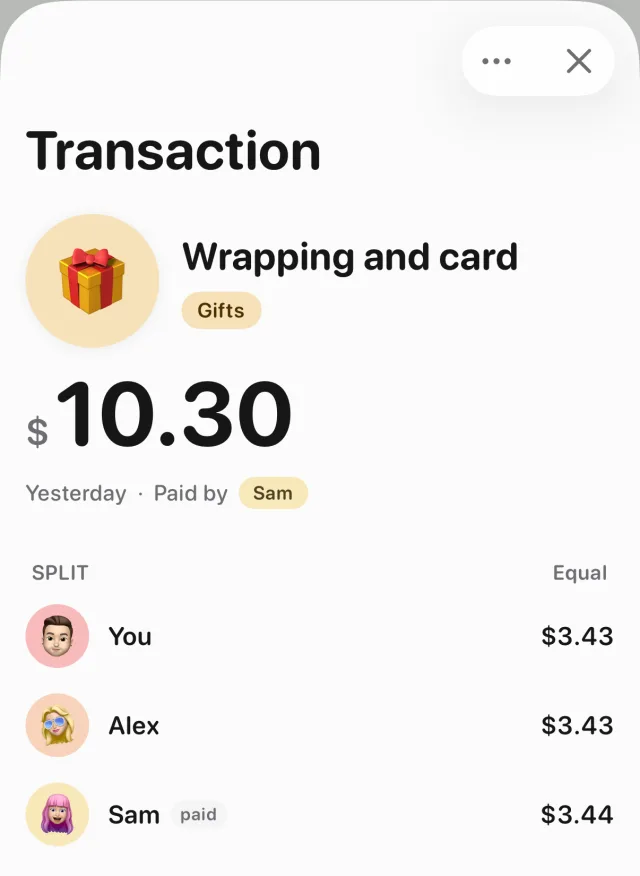
Sam picks up wrapping paper ($5.80) and a card ($4.50), which is another $10.30.
Total cost of the gift: $209.70 + $10.30 = $220.00, under the $225 ceiling.
Each share: $220.00 ÷ 3 = $73.333..., which doesn't divide evenly. Round down to $73.33 and three shares make $219.99, one cent short. So one person pays $73.34. It doesn't matter much who; a tidy rule is that someone who was already out of pocket takes it. Here that's Sam.
| Sibling | Paid | Share | Result |
|---|---|---|---|
| You | $209.70 | $73.33 | Owed $136.37 |
| Alex | $0 | $73.33 | Owes $73.33 |
| Sam | $10.30 | $73.34 | Owes $63.04 |
| Total | $220.00 | $220.00 |
Checking the arithmetic: $73.33 + $73.33 + $73.34 = $220.00. Sam already spent $10.30, so Sam owes $73.34 minus $10.30, which is $63.04. Alex's $73.33 plus Sam's $63.04 is $136.37, exactly what you're owed.
Two payments, both to you, and everyone has paid a third.
Shipping, tax, wrapping and the card
The price on the product page is rarely what the group actually spends. Before you announce the amount, count:
- Sales tax and shipping, as charged on the receipt.
- Gift wrap, a gift bag or a box.
- The card. One card signed by everyone is part of the gift, so it goes in the total.
- Delivery to the recipient, if the gift has to be mailed on.
The easy way to handle these is to split them the same way as the gift itself. If a second person buys the card or the wrapping, that's a second small bill, credited to them, as with Sam above.
If the gift comes in under the amount collected, say so and return the difference or lower everyone's share. If it would come in over the ceiling, ask before buying.
How to ask for the money
Ask once, clearly, right after you buy. A good request has four things: what was bought, the total with the receipt, each person's amount, and how and when to pay.
A message you can copy: "The gift for Mom and Dad is ordered! The total came to $220.00 with tax, shipping, wrapping and the card (receipt attached). That's $73.33 each. Alex, you owe me $73.33. Sam, you owe $63.04 after the wrapping you bought. Could you send it by Friday? A bank transfer or cash both work. Thanks!"
A few habits that keep it friendly:
- Send the receipt without being asked. A photo or screenshot answers the question nobody wants to type.
- Use exact amounts. "$73.33" gets paid faster than "about 75."
- Name a deadline. A date a few days out, or "before we give it to them," makes one reminder feel normal.
- Remind once, in the group, without names. "Still collecting for the gift, deadline is Friday" usually does it. After that, a private message is kinder than a public one.
The guide to splitting bills with friends has more on asking for money without the awkwardness.
Split a group gift in Tally
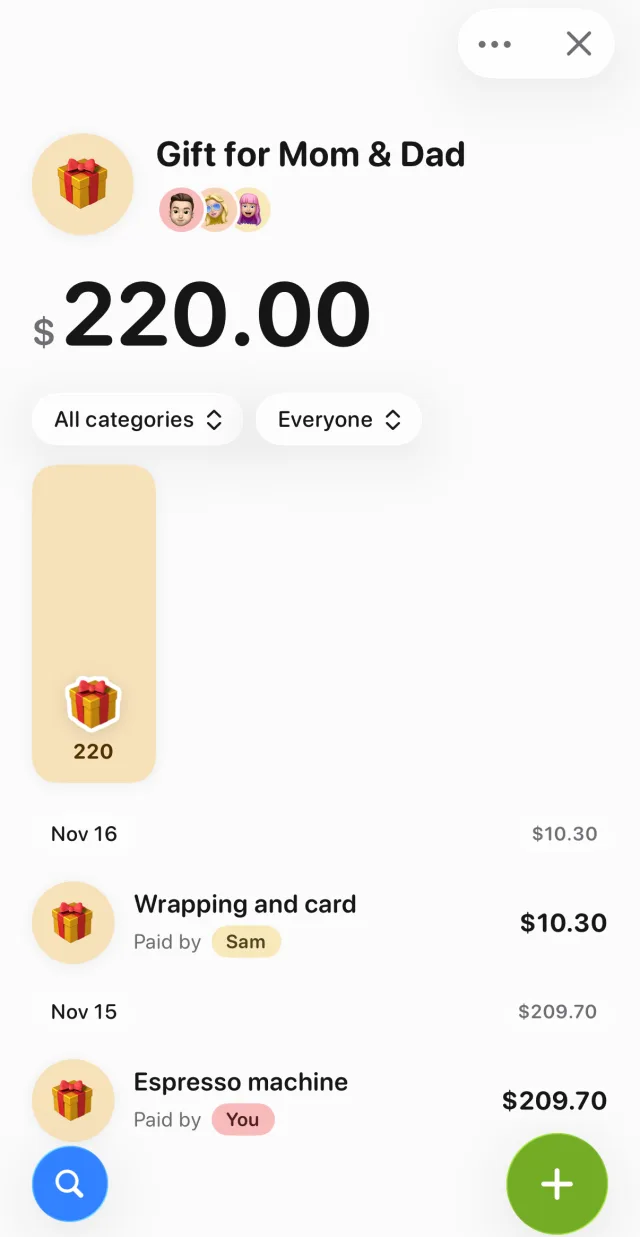
Tally does the dividing, tracks who has paid for what, and shows who owes whom. The screenshots below were made in Tally's demo mode with the numbers from this post.
1. Create an expense for the gift and add people by name. Tap Add person for each giver. They don't need the app or an account. If they'd like to see the bills themselves, they can join with the expense's code.
2. Add each purchase with its full amount and who paid. The machine goes in as $209.70 paid by you. The wrapping and card go in as a second bill, $10.30 paid by Sam, since each bill has one payer.
3. Choose the split. Tally has three:
- Equal: divides the bill among everyone you leave tapped in. When it doesn't divide evenly, Tally hands the extra cent to one person (the payer, when they're part of the split), so the shares always add up.
- %: for tiers. Type 40, 35 and 25 and Tally shows each person's dollar amount. The percentages need to add up to 100.
- Exact: for chip in what you can. Type each person's amount; they need to add up to the bill.
4. Open Settle Up. It shows each person's balance and a short list of suggested payments that brings everyone to zero.
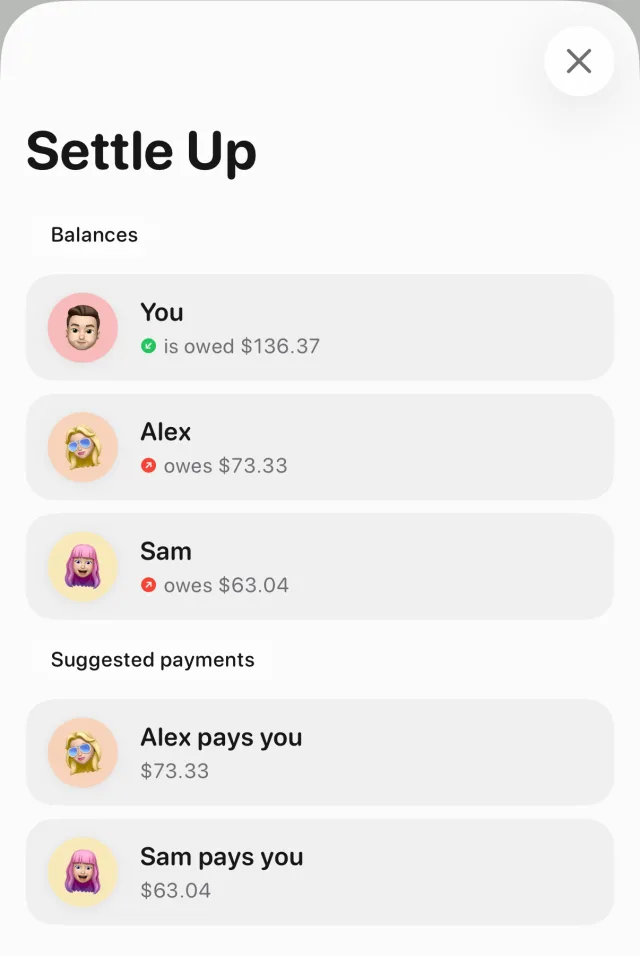
Tally shows who pays whom; you send the money yourselves however you usually do.
If you're keeping a holiday budget, only your share of the gift ($73.33 here, not the $209.70 on your card) counts against your gifts line. And if the gift is a dinner out, the restaurant bill guide covers tax, tip and a covered guest.
Splitting and Settle Up are in the free plan, which includes up to 5 expenses you create. Tally+ removes the cap.

Tally: expense tracker and bill splitter
Log what you spend, split bills with friends in any currency, and see who owes whom when it's time to settle up. Set category budgets and watch them as you go. Free to start.

Common questions
How do you split the cost of a group gift fairly?
Agree on a per-person ceiling first, then divide the full cost (gift, tax, shipping, wrapping and card) equally. If budgets differ a lot, agree on percentages or let each person choose an amount.
What if the total doesn't divide evenly?
Round each share down to the cent and give the leftover cent or two to one person, such as the buyer. $220.00 among three is $73.33, $73.33 and $73.34.
Should everyone pay the same for a group gift?
Not necessarily. Equal shares are the simplest, but siblings with different incomes often use tiers, and office or class gifts usually work better when each person gives what they choose.
What happens if someone drops out of a group gift?
Before the purchase, recalculate with the smaller group or pick a cheaper gift, and tell everyone the new amount. After the purchase, the usual expectation is that people who said yes still pay their share.
Who should buy the group gift?
One person, ideally the one who can wait a few days to be paid back. They keep the receipt and send the request for money as soon as the order is placed.
How much should each person give for an office gift?
There's no set amount. Keep it optional, suggest a small figure if people ask, and check your workplace's gift policy before collecting for a manager.